


- The Roundhill Magnificent Seven Plus ETF (MAGP) adds Broadcom, SpaceX, Anthropic, and OpenAI to the original seven, covering the AI stack from chips to frontier models.
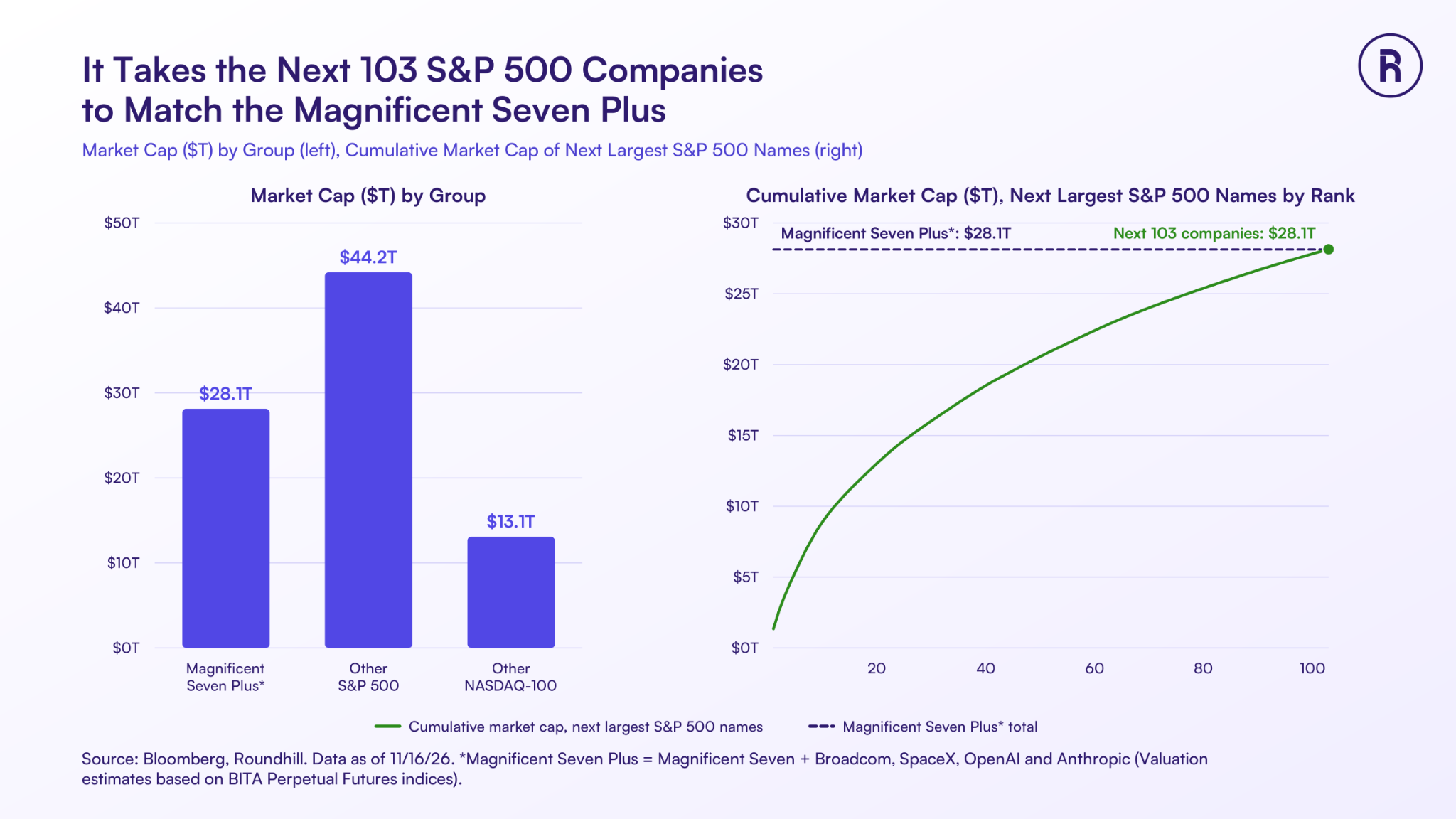
- It takes the next 103 largest S&P 500 companies combined to match the Magnificent Seven Plus’s $28.1T in market value.
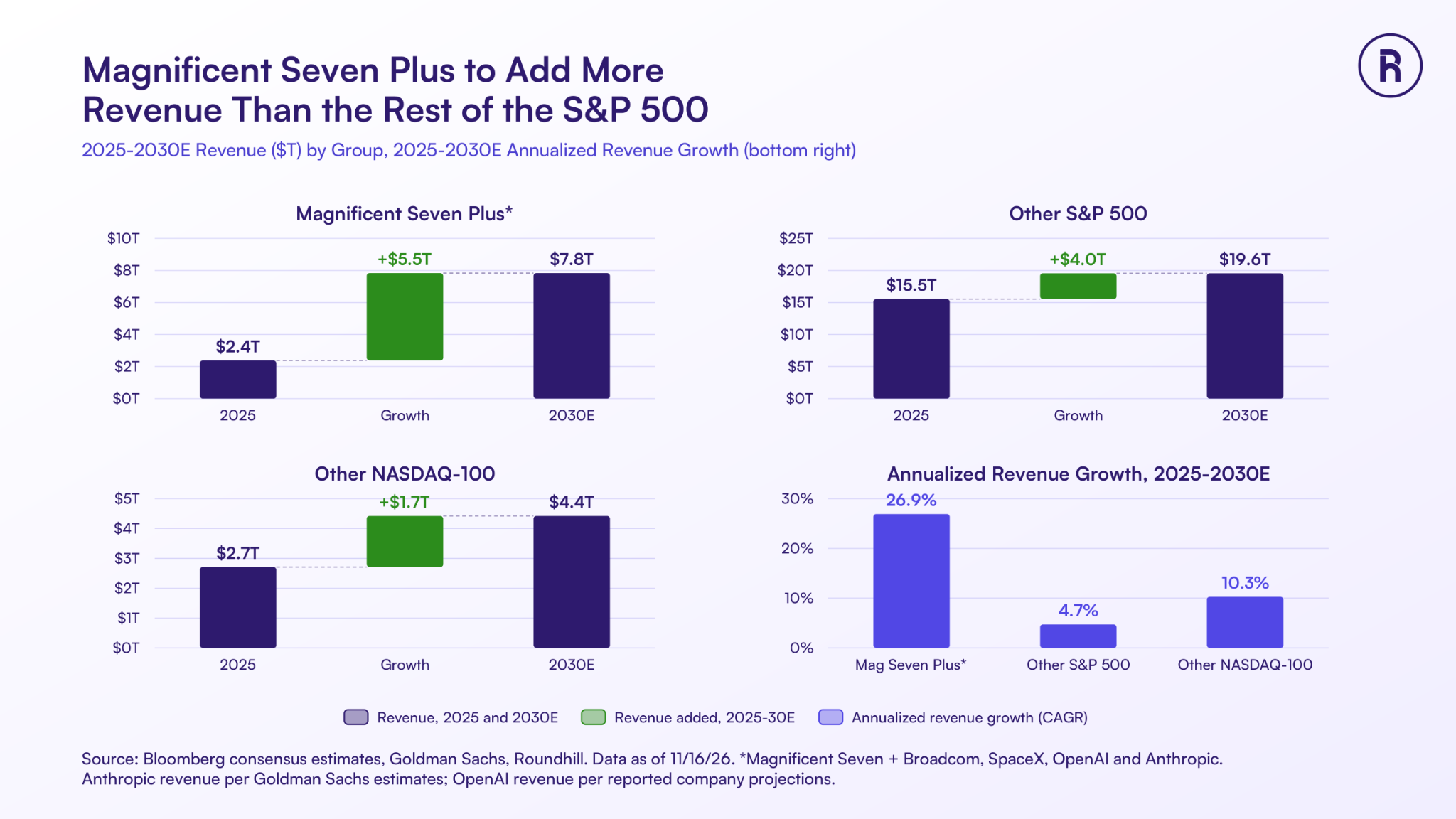
- The group is expected to add $5.5T in revenue by 2030, more than the rest of the S&P 500 combined, with revenue growth nearly 6x faster.
“Magnificent” Expansion
“Magnificent” is getting bigger. The Roundhill Magnificent Seven Plus ETF (MAGP), launched November 12, 2026, holds the original Magnificent Seven: Apple (AAPL), Amazon (AMZN), Alphabet (GOOGL), Meta Platforms (META), Microsoft (MSFT), Nvidia (NVDA), and Tesla (TSLA). But it also adds four more: Broadcom (AVGO), SpaceX (SPCX), newly public Anthropic (ANT), and privately held OpenAI (OAI).1
Why the expansion? Well, together they span the AI stack, they’re worth more than the next 100 largest S&P 500 companies combined, and they’re expected to add more revenue than the rest of the S&P 500 by 2030.
Eleven Names, Full AI Stack
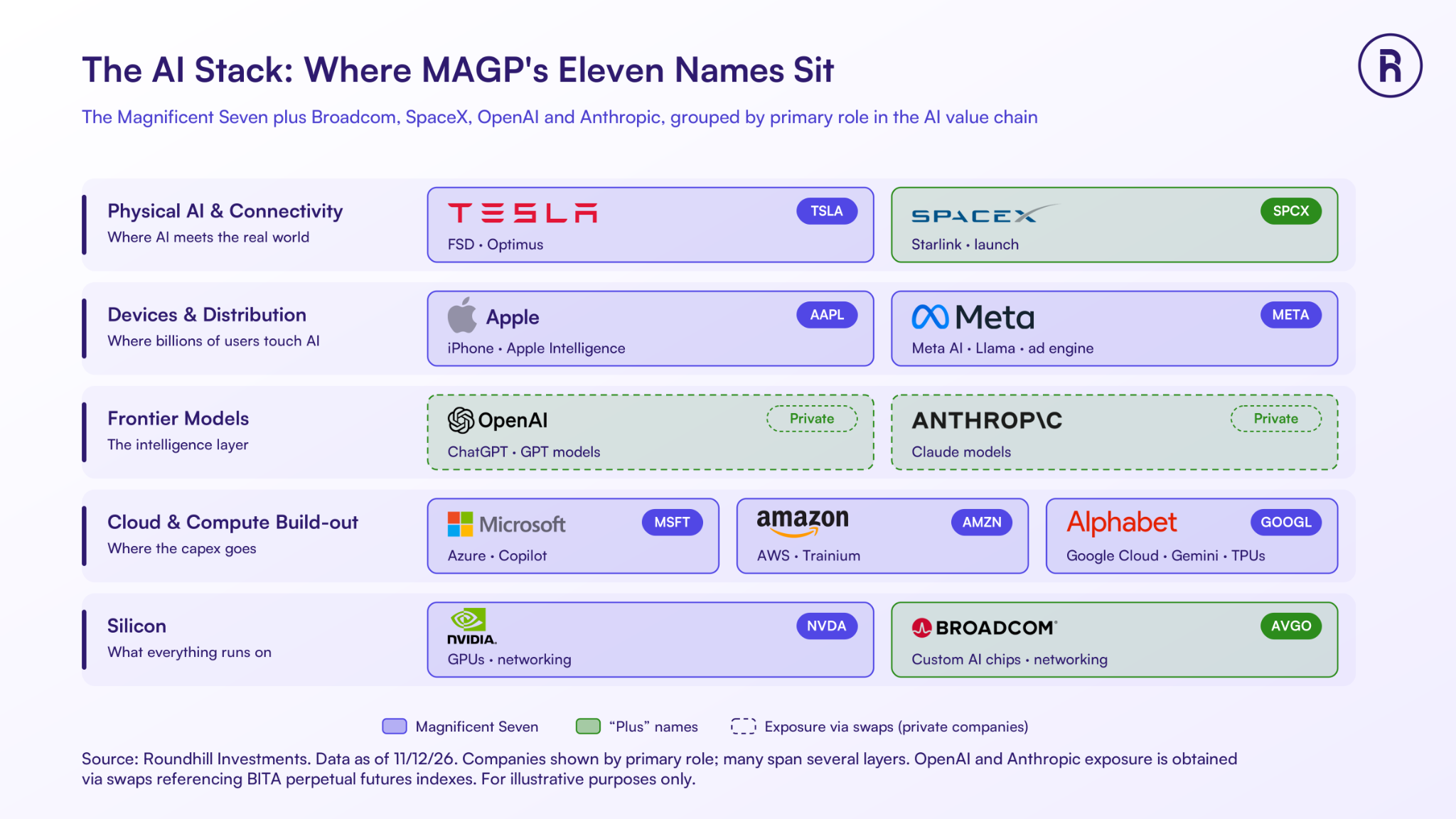
MAGP covers the major layers of the AI stack. NVDA and AVGO make the chips. MSFT, AMZN, and GOOGL run the cloud where AI is built and hosted. AAPL and META put AI in front of billions of users. TSLA and SPCX bring AI into the physical world, from self-driving cars to satellite networks. New to the expanded “Magnificent” group are ANT and OAI, the frontier model companies building AI software tools. As the technology evolves, we think exposure across the stack will be important for investors.
Bigger Than the Next 100
Combined, the Magnificent Seven Plus are worth $28.1T in market value. That’s more than double the rest of the NASDAQ-100 ($13.1T). The rest of the S&P 500 is worth $44.2T, but it takes the next 103 largest stocks in the index to match the Magnificent Seven Plus. In our opinion, that’s a sign investors are recognizing the importance of the Magnificent Seven Plus.
And Better Growth Than the Rest
To us, these big innovators have better growth potential. This shows up in sales growth expectations. From 2025 to the end of this decade, the Magnificent Seven Plus are estimated to add $5.5T in revenue. That’s more than the rest of the S&P 500 combined ($4.0T). In percentage terms, Magnificent Seven Plus revenue is forecast to grow 26.9% per year, nearly 6x the rest of the S&P 500 (4.7%) and over 2.5x faster than the rest of the NASDAQ-100 (10.3%).
Earned Their Place
The newcomers pull their weight. For example, ANT is expected by analysts to add more revenue than any company in the group except NVDA and AMZN, with SPCX right behind. As AI continues to evolve, we believe what markets view as “magnificent” will expand. We believe AVGO, SPCX, ANT, and OAI have earned their place alongside the original Magnificent Seven given their ties to technological innovation, sheer size, and impressive growth outlook.
To learn more about MAGP and its current holdings, click here: https://www.roundhillinvestments.com/etf/magp/
1 MAGP gets its exposure to Anthropic and OpenAI through total return swaps that reference the BITA SI Anthropic and OpenAI Perpetual Futures Indices, which are derived from perpetual futures on each company. The Fund does not own shares of either company.
Glossary
AI Stack: The layers of technology and business that together deliver artificial intelligence, from the hardware at the bottom to the products people use at the top. A common framing runs: silicon (the chips that train and run AI models); cloud and compute infrastructure (the data centers that host them); frontier models (the large AI systems themselves); devices and distribution (the phones, apps and platforms where people use AI); and physical AI (AI built into real-world systems such as vehicles, robots and satellite networks). Many companies operate in more than one layer.
Annualized Growth (Compound Annual Growth Rate, or CAGR): The steady rate at which a value would have to grow each year to get from its starting level to its ending level over a given period. It smooths out year-to-year swings into one comparable yearly rate. The formula is (Ending Value ÷ Beginning Value)^(1 ÷ Number of Years) − 1. For example, revenue rising from $2.4 trillion in 2025 to an estimated $7.8 trillion in 2030 works out to about 26.9% compound annual growth. Revenue won’t actually rise by exactly that much every year.
BITA SI Anthropic and OpenAI Perpetual Futures Indices: Indices calculated and published by BITA GmbH, a Germany-based index provider. Each one tracks the value of a privately held company, Anthropic or OpenAI, using trades in perpetual futures contracts (perps) on that company. A periodic “funding rate” payment between buyers and sellers keeps their price in line with the underlying value. The index value is set using eligible trades across a limited number of vetted trading platforms. It takes a volume-weighted median price on each platform and combines them into a weighted average.
NASDAQ-100 Index: An index of the 100 largest non-financial companies listed on the Nasdaq stock exchange, including some based outside the U.S. It leans heavily toward technology, but also includes consumer, healthcare, industrial and communication companies. Companies are weighted by market value, with limits that keep any single company from dominating. Membership is reviewed each December.
Perpetual futures (perps): Futures contracts where trading is meant to mimic the price of an asset, or in this case a company’s valuation, without an expiration date. They can deviate from underlying value. Traders can hold a position as long as they like, oftentimes with leverage, and a periodic “funding” payment between buyers and sellers keeps the contract price close to the reference price. Perps are most commonly traded on crypto exchanges. For private companies like Anthropic and OpenAI, they offer a market-based read on what traders think the company is worth before it lists. They are a signal of trader expectations, not an official valuation.
S&P 500 Index: A widely followed index of about 500 of the largest U.S. publicly traded companies, often used as a stand-in for the overall U.S. stock market. A committee at S&P Dow Jones Indices picks the members based on size, trading activity and profitability. Companies are weighted by market value, so the largest have the biggest influence on the index’s moves.
Total Return Swap (on an Index): A contract between two parties, usually a fund and a large bank, that gives the fund the economic return of an index without owning what the index tracks. The fund receives the index’s total return on an agreed dollar amount, called the notional amount. That return is any gain plus any income, and if the index falls, the fund pays the loss instead. In exchange, the fund pays the bank a financing fee, typically a floating interest rate plus a spread.
Disclosures
Investors should consider the investment objectives, risks, charges, and expenses carefully before investing. For a prospectus or summary prospectus, if available, with this and other information about the Fund, please call 1-855-561-5728 or visit our website at www.roundhillinvestments.com/etf/MAGP. Read the prospectus or summary prospectus carefully before investing.
Pre-IPO Companies Risk. The Fund may obtain exposure to the Pre-IPO Companies through swap agreements that provide exposure to a Pre-IPO Company via the respective Pre-IPO Index. The Fund may be unable to obtain or maintain the desired exposure to one or more Pre-IPO Companies, and any available exposure may be limited, expensive, indirect, and/or difficult to value. Information regarding private companies is less available than information regarding public companies and private companies are not subject to the same governance, disclosure, and other regulatory requirements as public companies. As a result, private companies may be difficult to accurately value and such valuations may be based on models or estimates that may not accurately reflect the value of the company. These valuation risks may also affect futures contracts, swaps or other instruments that reference Pre-IPO Companies. Private companies and instruments referencing private companies may be less liquid than other investments and may be subject to increased volatility. The timing and potential value of any public offering of securities of the Pre-IPO Companies is uncertain and such offering may never occur.
Perpetual Futures Risk. The Fund may obtain exposure to the Pre-IPO Companies prior to any public offering of such company primarily through swap agreements that reference the Pre-IPO Indexes. The Pre-IPO Indexes calculate the price of the respective Pre-IPO Company by taking the volume-weighted median of each eligible trading platform on which the perpetual futures trade and calculating a weighted-average price across such platforms. Perpetual futures contracts generally do not have a fixed expiration date and are designed to provide ongoing economic exposure to a reference asset through a funding-rate mechanism. Perpetual futures contracts may be less liquid, less transparent, and more volatile than markets for publicly-traded securities or exchange-traded futures contracts, and there may be no liquid or developed market for perpetual futures contracts referencing the Pre-IPO Companies. Valuation for pre-IPO perpetual futures contracts is derived from available information and modeling, which could lead to significant volatility. Lack of information and liquidity and limitations in the ability to hedge positions may cause wider spreads and increased volatility. Perpetual futures contracts for pre-IPO securities also utilize “funding rates,” or payments exchanged between holders of long and short positions, which may impact the value of the Fund’s holdings. Additionally, market dislocations, limited liquidity, trading restrictions, operational issues, settlement risks, and regulatory developments may impact the value of the perpetual futures contracts that comprise the Pre-IPO Indexes, and accordingly, could negatively impact the Fund. Additionally, unlike the valuation of a publicly traded security, valuation of the Pre-IPO Companies for the perpetual futures contracts may be subject to limited information and may not reflect the eventual value and trading price of the company after its shares are publicly listed. Once a Pre-IPO Company’s shares are publicly traded, the Fund will obtain exposure to such company through the listed equity securities. Further, the Adviser expects the value of the Pre-IPO Index will converge with the ultimate trading price of the respective Pre-IPO Company. Any divergence between the valuation of the perpetual futures that comprise the Pre-IPO Index and the ultimate share trading price of the respective Pre-IPO Company after its IPO may result in a loss for the Fund.
Active Management Risk. The Fund is actively-managed and its performance reflects investment decisions that the Adviser makes for the Fund. Such judgments about the Fund’s investments may prove to be incorrect. If the investments selected and the strategies employed by the Fund fail to produce the intended results, the Fund could underperform as compared to other funds with a similar investment objective and/or strategies, or could have negative returns. The Adviser/Sub-Adviser (defined below) will seek to employ the Fund’s investment strategy regardless of whether there are periods of adverse market, economic, or other conditions and will not seek to take temporary defensive positions during such periods.
Artificial Intelligence (“AI”) Companies Risk. Companies that rely on, develop, integrate or are otherwise engaged in AI and big data typically face intense competition and potentially rapid product obsolescence. These companies are also heavily dependent on intellectual property rights and may be adversely affected by loss or impairment of those rights. There can be no assurance these companies will be able to successfully protect their intellectual property to prevent the misappropriation of their technology, or that competitors will not develop technology that is substantially similar or superior to such companies’ technology. AI and big data companies typically engage in significant amounts of spending on research and development, as well as mergers and acquisitions, and there is no guarantee that the products or services produced by these companies will be successful. The products and services of AI and big data companies may face obsolescence due to rapid technological developments and frequent new product or service introduction, unpredictable changes in growth rates and competition for the services of qualified personnel. AI and big data companies are potential targets for cyberattacks, which can have a materially adverse impact on the performance of these companies. In addition, AI technology could face increasing regulatory scrutiny in the future, which may limit the development of this technology and impede the growth of companies that develop and/or utilize this technology. Similarly, the collection of data from consumers and other sources could face increased scrutiny as regulators consider how the data is collected, stored, safeguarded and used. AI and big data companies may face regulatory fines and penalties, including forced break-ups, that could hinder the ability of the companies to operate on an ongoing basis. The customers and/or suppliers of AI and big data companies may be concentrated in a particular country, region or industry. Any adverse event affecting one of these countries, regions or industries could have a negative impact on AI and big data companies. Country, government, and/or region-specific regulations or restrictions could have an impact on AI and big data companies.
Concentration Risk. The Fund expects to have concentrated (i.e., invest more than 25% of its total assets) investment exposure in the industry or group of industries that comprise the information technology sector. As a result, the Fund is more vulnerable to adverse market, economic, regulatory, political or other developments affecting those industries or groups of related industries than a fund that invests its assets in a more diversified manner.
Counterparty Risk. Fund transactions involving a counterparty are subject to the risk that the counterparty will not fulfill its obligation to the Fund. Counterparty risk may arise because of the counterparty’s financial condition (i.e., financial difficulties, bankruptcy, or insolvency), market activities and developments, or other reasons, whether foreseen or not. A counterparty’s inability to fulfill its obligation may result in significant financial loss to the Fund. The Fund may be unable to recover its investment from the counterparty or may obtain a limited recovery, and/or recovery may be delayed.
Derivatives Risk. The Fund expects to use swap agreements to seek to achieve its investment objective. The Fund’s derivative investments have risks, including the imperfect correlation between the value of such instruments and the reference asset; the loss of principal, including the potential loss of amounts greater than the initial amount invested in the derivatives instrument; and illiquidity of the derivative investments. The Fund expects to primarily utilize derivatives instruments that are not designed to produce leverage. The Fund, however, may invest in derivatives that give rise to economic leverage, but expects any such economic leverage to be minimal. Leverage magnifies the potential for gain and may result in greater losses, which in some cases may cause the Fund to liquidate other portfolio investments at inopportune times (e.g., at a loss to comply with limits on leverage imposed by the 1940 Act or when the Adviser otherwise would have preferred to hold the investment) or to meet redemption requests. Certain of the Fund’s transactions in derivatives also could affect the amount, timing, and character of distributions to shareholders, which may result in the Fund realizing more short-term capital gain and ordinary income subject to tax at ordinary income tax rates than it would if it did not engage in such transactions, which may adversely impact the Fund’s after-tax returns. Any financing, borrowing or other costs associated with using derivatives also may have the effect of lowering the Fund’s return. To the extent the Fund invests in derivatives instruments that give rise to economic leverage, the value of the Fund’s portfolio is likely to experience greater volatility over short-term periods. The Fund is subject to regulatory constraints relating to the level of leverage risk, as measured by value-at-risk (VaR) testing, the Fund may incur through its derivatives investments. To the extent the Fund exceeds these regulatory constraints regularly or over an extended period, the Fund may determine it is necessary to make adjustments to the Fund’s investment strategies to reduce its use of derivatives. Any such adjustments may adversely affect the Fund’s ability to achieve its investment objective and its performance. Additionally, certain derivatives trade OTC and may be privately negotiated, which may subject them to liquidity and valuation risk. A lack of liquidity may cause the value of a derivative instrument to decline and exhibit price behavior that does not correlate with the underlying securities. To the extent the Fund needs additional counterparties for any OTC derivative instruments, if it is unable to obtain a suitable counterparty, the Fund may not achieve its investment objective. It may not be possible to liquidate such instruments at an advantageous time or price, which may result in significant losses.
Focused Investment Risk. The Fund invests in a limited number of issuers involved in the types of businesses listed below. Because of this, the Fund is more susceptible to adverse economic, political, regulatory, market or other events affecting any one of those issuers (including for reasons directly related to the issuer, such as management performance and reduced demand for the issuer’s goods or services), or the industries or sectors in which they operate. The Fund’s performance may therefore depend to a greater extent on how a small number of issuers perform. A decline in the value of, or other negative developments affecting, even one of those issuers or businesses could significantly reduce the Fund’s value. As a result, the value of Fund Shares may be more volatile than if the Fund invested in a larger number of issuers.
Information Technology Companies Risk. Information technology companies face intense competition, both domestically and internationally, which may have an adverse effect on profit margins. Like other technology companies, information technology companies may have limited product lines, markets, financial resources or personnel. The products of information technology companies may face obsolescence due to rapid technological developments, frequent new product introduction, unpredictable changes in growth rates and competition for the services of qualified personnel. Companies in the information technology sector are heavily dependent on patent and intellectual property rights. The loss or impairment of these rights may adversely affect the profitability of these companies. Information technology companies are facing increased government and regulatory scrutiny and may be subject to adverse government or regulatory action.
IPO Risk. The Fund may invest in securities offered in an IPO or in companies that have recently completed an IPO. The market value of IPO shares can have significant volatility due to factors such as the absence of a prior public market, unseasoned trading, a small number of shares available for trading and limited information about the issuer. The purchase of IPO shares may involve high transaction costs, and the Fund may lose money on an investment in such securities.
New Fund Risk. The Fund is a recently organized investment company with a limited operating history. As a result, prospective investors have a limited track record or history on which to base their investment decision.
Non-Diversification Risk. As a “non-diversified” fund, the Fund may hold a smaller number of portfolio securities than many other funds. To the extent the Fund invests in a relatively small number of issuers, a decline in the market value of a particular security held by the Fund may affect its value more than if it invested in a larger number of issuers. The value of the Fund Shares may be more volatile than the values of shares of more diversified funds.
Semiconductors Companies Risk. Competitive pressures may have a significant effect on the financial condition of semiconductor companies and, as product cycles shorten and manufacturing capacity increases, these companies may become increasingly subject to aggressive pricing, which hampers profitability. Reduced demand for end-user products, underutilization of manufacturing capacity, and other factors could adversely impact the operating results of semiconductors companies. Semiconductor companies typically face high capital costs and may be heavily dependent on intellectual property rights. Semiconductors companies are highly cyclical, which may cause the operating results of many of such companies to vary significantly. The stock prices of semiconductors companies have been and likely will continue to be extremely volatile.
Software Companies Risk. Software companies publish and distribute software for the business or consumer markets, as well as companies that provide consulting or integration services to other businesses relating to information technology, including computer-system design, system integration, network and systems operations, cloud computing, distributed ledger technology consulting and integration, data management and storage, repair services, and technical support. In addition, software companies also include those companies involved in digital platforms that primarily generate revenue from advertising, content delivery, and other virtual products for consumers. Software companies are subject to significant competitive pressures, such as aggressive pricing, new market entrants, competition for market share, short product cycles due to an accelerated rate of technological developments and the potential for limited earnings and/or falling profit margins. These companies also face the risks that new services, equipment or technologies will not be accepted by consumers and businesses or will become rapidly obsolete. These factors can affect the profitability of these companies and, as a result, the value of their securities. Patent protection is integral to the success of many software companies. In addition, many software companies have limited operating histories. Prices of these companies’ securities historically have been more volatile than other securities, especially over the short term.
Swap Agreements Risk. Swap agreements may involve greater risks than direct investment in securities, and are subject to additional risks such as credit risk, counterparty risk and valuation risk. Swap agreements are entered into primarily with major financial intermediaries for a specified period which may range from one day to more than one year. In a standard swap transaction, two parties agree to exchange the return (or differentials in rates of return) earned or realized on particular predetermined reference or underlying securities or instruments. The gross return to be exchanged or swapped between the parties is calculated based on a notional amount or the return on or change in value of a particular dollar amount invested in a reference asset. Swap agreements are generally traded OTC, and therefore, may not receive regulatory protection, which may expose investors, including the Fund, to significant losses. A swap agreement could result in losses if the underlying reference or asset does not perform as anticipated. Additionally, the swap agreements utilized by the Fund to obtain exposure to the Pre-IPO Companies may include higher margin and financing rates than other swap agreements, either of which could negatively impact the performance of the Fund.
Roundhill Financial Inc. serves as the investment advisor. The Funds are distributed by Foreside Fund Services, LLC which is not affiliated with Roundhill Financial Inc., U.S. Bank, or any of their affiliates.