What happened with the SpaceX ETFs?
In the lead up to the SpaceX IPO, a ton of money flowed into ETFs that owned (and actively marketed) their positions in SpaceX, generally held via a Special Purpose Vehicle (SPV)¹. In theory this sounded great, as ETF investors gained early access to what was the hottest IPO ever at the time.
So what could go wrong? Now that SpaceX has been public for a few months, we have a pretty good answer.
The problem lies in the mismatch between the open-ended nature of the ETF wrapper, the limited availability of pre-IPO shares (via SPV or otherwise), and the general expectation amongst ETF holders that they’ll participate in the “IPO pop.” At the same time, a newer instrument, the pre-IPO perpetual future (“perp”)², priced the SpaceX listing relatively accurately, allowing for price discovery leading into IPO day. We think perps may be a better fit for the ETF wrapper than SPVs or even direct cap table positions, and SpaceX is a good case study for why.
What’s the issue with holding private shares in an ETF?
By definition, an ETF is an open-ended fund. As an open-end structure, money flows into and out of ETFs through creations and redemptions every day based on underlying demand. Private positions, on the other hand, are difficult to readily buy or sell. The result can be dilution when new money comes into the fund and concentration when money heads out.
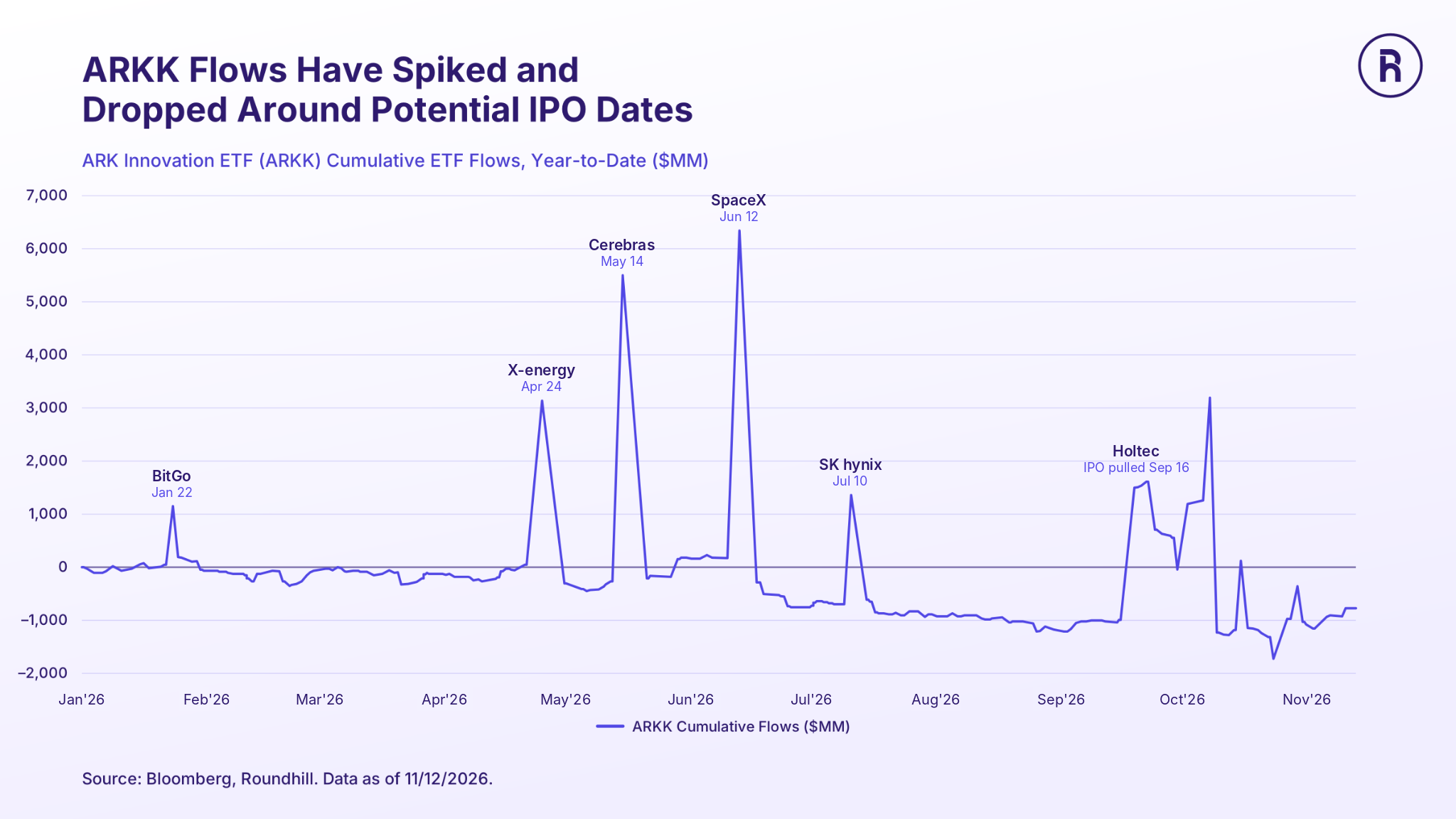
We’ve seen the first half of this clearly in the ARK Innovation ETF (ARKK). The chart below shows ARKK’s cumulative net flows year to date through November 12. Each spike represents arbitrageurs putting new money into the ETF ahead of a potential IPO allocation. Then the money flows out once the IPO is done. The largest spike of the year came on June 12, the day SpaceX listed. The mathematical effect is simple dilution.
Past performance does not guarantee future results. The performance data quoted represents past performance and current returns may be lower or higher. The investment return and principal will fluctuate so that an investor’s shares when redeemed may be worth more or less than the original cost. Extraordinary performance is attributable in part due to unusually favorable market conditions and may not be repeated or consistently achieved in the future. The Fund’s most recent month-end performance and standardized performance can be found at www.ark-funds.com/funds/arkk#performance
Let’s say an ETF owns a 10% position in a private company, and the fund assets grow 10x (an extreme, but theoretically possible example) in the days leading into the IPO. Unless the ETF manager can add to the position proportionally as new money rolls in (and with a private company, they generally can’t), the 10% position becomes a 1% position. If the stock then pops 100% on IPO day, the fund sees a 1% NAV benefit, rather than a potential 10% NAV benefit. While not catastrophic, this arguably eliminates most, if not all, of the benefit of the ETF buying prior to the IPO.
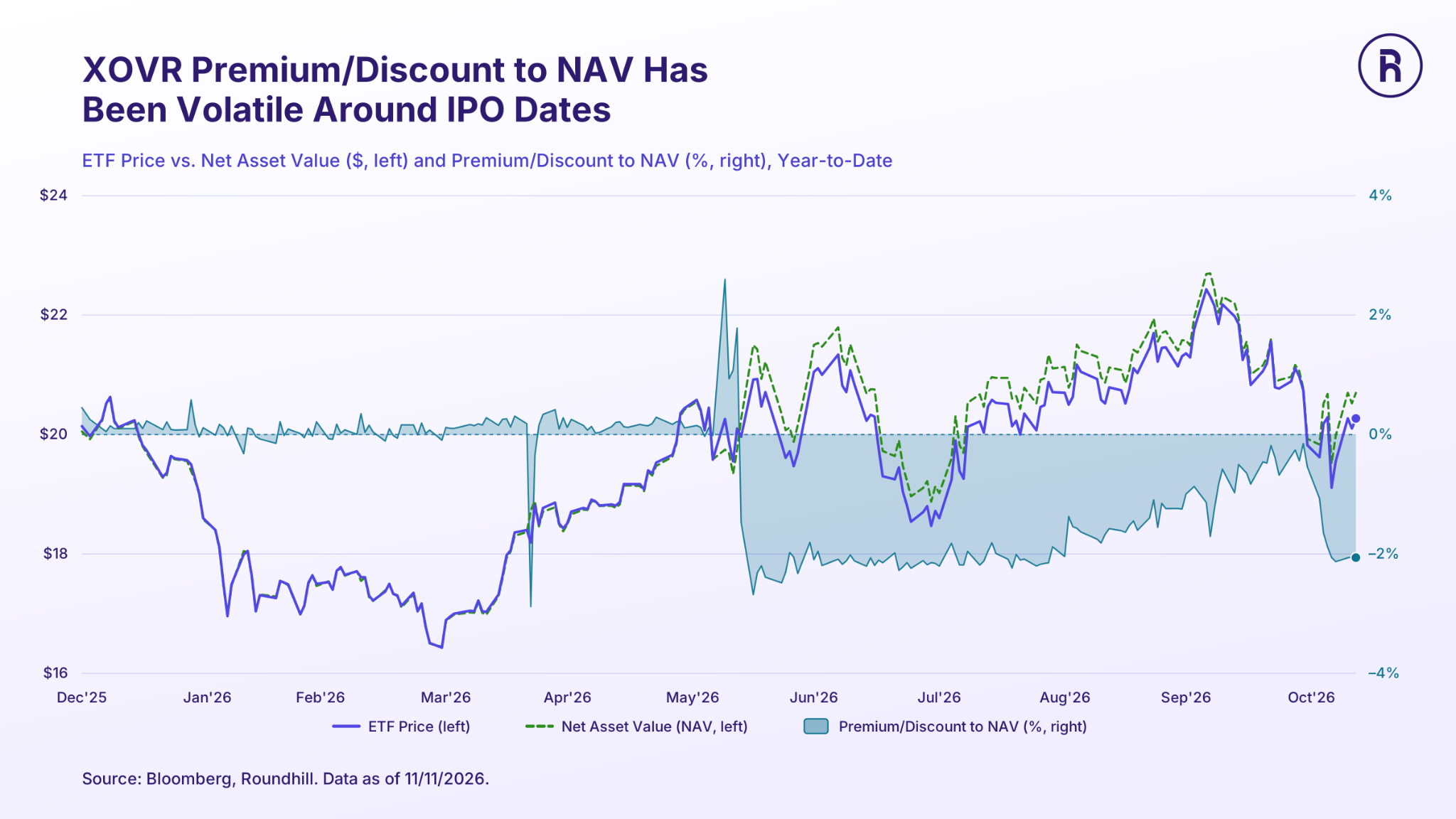
We saw this play out with ERShares Private-Public Crossover ETF (XOVR), the largest of the ETFs with SpaceX exposure. In January 2026, XOVR’s assets went from roughly $400 million to roughly $1.8 billion. By the manager’s own account, its SpaceX weight was diluted from roughly 10% to less than 2% as a result. Leading into the June IPO, with assets at roughly $2.4 billion, the manager implemented what it called a “Shareholder Protection Plan,” which included limits on large, short-term creations and transaction fees on redemptions.
Limiting creations and/or redemptions is generally an extreme action for ETFs to take, and XOVR’s premium/discount history shows why. In the days leading into the IPO, with creations limited and new money still buying the ETF, the premium spiked to roughly 2.6%. Following the IPO, flows reversed and the fund flipped to a discount of roughly 2%, which persisted for about three months. In other words, an investor who bought at the peak premium and sold at the discount would have given up over 4%, before accounting for the performance of the underlying holdings.
Past performance does not guarantee future results. The performance data quoted represents past performance and current returns may be lower or higher. The investment return and principal will fluctuate so that an investor’s shares when redeemed may be worth more or less than the original cost. Extraordinary performance is attributable in part due to unusually favorable market conditions and may not be repeated or consistently achieved in the future. The Fund’s most recent month-end performance and standardized performance can be obtained by calling +1 (617) 279 0045 or visiting entrepreneurshares.com/xovr-etf/
But the real issue might relate to what happens post-IPO, with the added complication of a lock-up. SpaceX’s lock-up runs through December, meaning the SPV shares can’t be sold in the interim. Any subsequent redemptions would increase the fund’s % weight in locked-up SpaceX shares. This could very well result in an outsized position in an illiquid holding, creating several potential issues, not the least of which is a potential breach of the 15% illiquid limit under Rule 22e-4³.
Direct cap table ownership avoids some of the SPV-specific issues, but the position is still illiquid, fair valued, and still can’t scale with the fund. Fees are also worth considering. Most SPVs charge an upfront fee, an annual management fee, and carried interest on gains. Direct ownership avoids these fees. However, the company generally has to approve the transfer, and blocks tend to be large and infrequent, which is why most ETFs end up in SPVs.
Why are perps a better fit?
A pre-IPO perp is a derivative contract that tracks the market’s expectation of a private company’s value. Perps trade around the clock and carry no shares in, or claim on, the underlying company, but their price reflects the market’s view of its value. An ETF such as the Roundhill Magnificent Seven Plus ETF (MAGP) accesses perp exposure through a total return swap⁴ with a bank counterparty, the same tool we use in funds like the Roundhill Magnificent Seven ETF (MAGS).
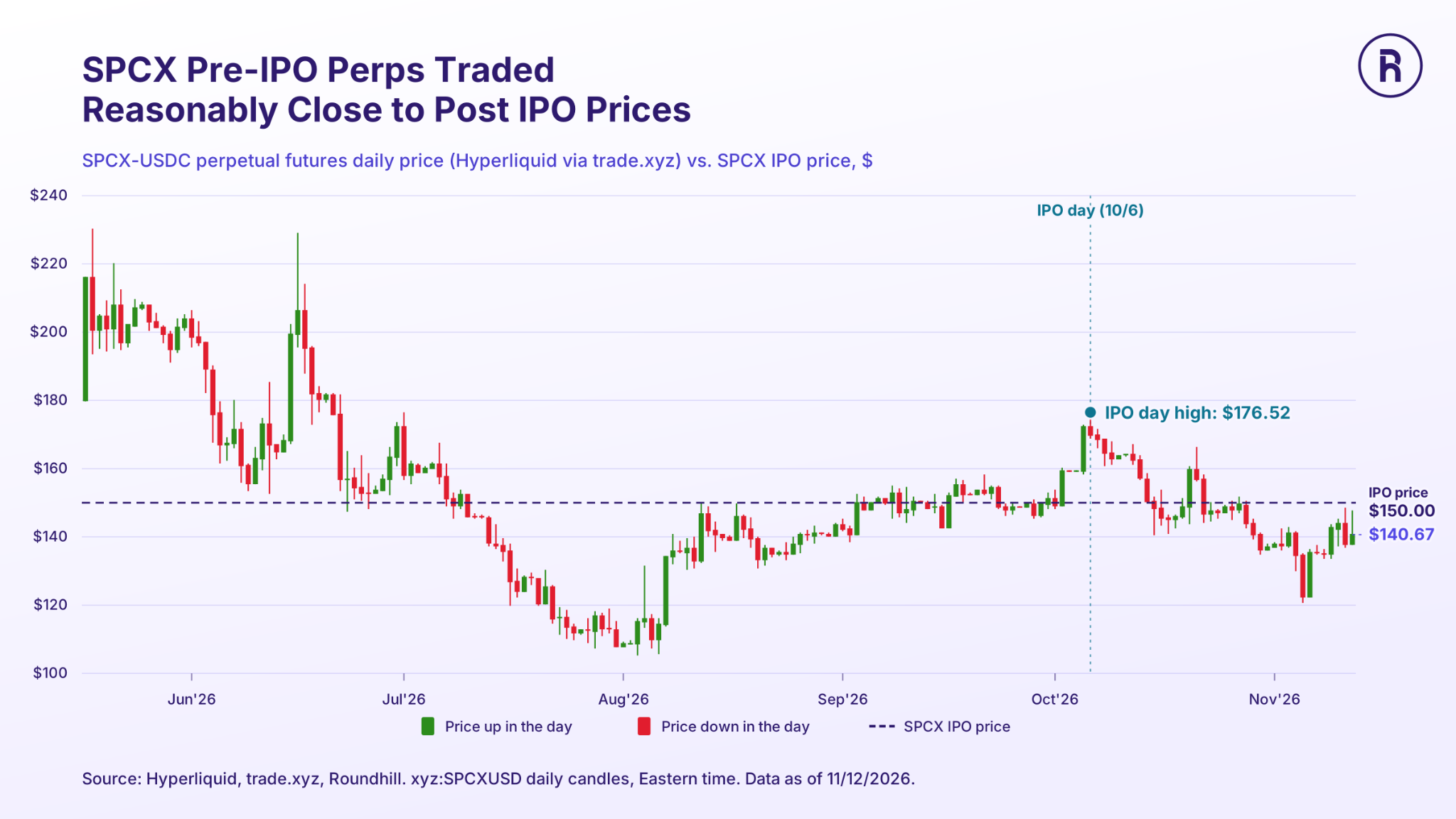
SpaceX was arguably the first test of these contracts at real scale and, in our view, they held up well. The most active perp on Hyperliquid’s Trade[XYZ] launched in mid-May and traded around the clock leading into the listing. It spent its first weeks above $200, then repriced after SpaceX set a fixed $135 IPO price in early June. In the final week before the IPO, it traded between roughly $155 and $180. SpaceX opened at $150, traded as high as $176.52, and closed its first day at $160.95.
Importantly, a swap on a perp (or even a perp directly) doesn’t have the liquidity mismatch problem. Swap exposure is based on notional, which can be adjusted daily. If the ETF’s assets 10x leading into an IPO, the ETF manager can scale the swap alongside it, and a 10% position stays a 10% position. If the fund then sees redemptions post-IPO, the position can be reduced proportionally. A swap also isn’t subject to a lock-up, meaning the ETF manager can reduce or exit the exposure as soon as the stock lists. Because the reference asset is liquid, we would generally classify the swap as liquid under Rule 22e-4, rather than counting against the 15% illiquid limit.
What are the downsides?
This doesn’t mean perps are a panacea. Funding rates⁵ represent the cost of carry, and they were material in the lead up to the SpaceX IPO, when retail demand pushed the contracts to a premium. The exposure is synthetic, meaning the fund takes on swap counterparty risk and financing costs. And the venues are offshore and still maturing.
Most importantly, a perp is not an IPO allocation. Because perps trade freely leading into the listing, the market’s expectation of any IPO pop may in part be already reflected in the price. Perps offer exposure to the market’s view of a company before it lists. They don’t offer the IPO price.
What’s the takeaway?
ETFs offer daily liquidity and daily pricing in an open-ended wrapper. Perps, accessed via swap, allow an ETF to hold private company exposure that is marked to market daily and can be scaled up or down alongside creations and redemptions.
If you’re considering any ETF with pre-IPO exposure, look at how the exposure is obtained (SPV, direct, or synthetic), what the lock-ups might be, any embedded fees, and most importantly, what happens to the position’s weight as the fund’s shares outstanding change.
¹ Special Purpose Vehicle (SPV): A legal entity formed to hold shares of a private company on behalf of a group of investors, who own interests in the SPV rather than the underlying shares. SPVs typically charge management fees and carried interest and are subject to the private company’s transfer restrictions.
² Pre-IPO Perpetual Future (“perp”): A derivative contract with no expiry that tracks the implied valuation or share price of a private company. Perps are kept in line with their reference through periodic funding payments between longs and shorts. Holders receive no shares, no allocation, and no claim on the company.
³Rule 22e-4: is an SEC rule requiring mutual funds and certain ETFs to maintain a program for managing liquidity risk - the risk that a fund can’t sell investments quickly enough to meet investor redemptions. Funds must regularly review that risk, with board oversight, and generally limit hard-to-sell investments to 15% of net assets.
⁴ Total Return Swap (TRS): An agreement in which one party pays a set rate and the other pays the total return of a reference asset, allowing the receiver to gain exposure to the reference without owning it.
⁵ Funding Rate: The periodic payment exchanged between long and short holders of a perpetual future, which pushes the contract price toward its reference. When the contract trades above the reference, longs pay shorts, and vice versa.
Disclosures
All funds are managed differently and do not react the same to economic or market events. The investment objectives, strategies, policies or restrictions of other funds may differ and more information can be found in their respective prospectuses. Therefore, we generally do not believe it is possible to make direct fund to fund comparisons in an effort to highlight the benefits of a fund versus another similarly managed fund.
Investors should consider the investment objectives, risk, charges and expenses carefully before investing. For a prospectus or summary prospectus with this and other information about Roundhill ETFs please call 1-855-561-5728 or visit the website at www.roundhillinvestments.com/etf/MAGS and www.roundhillinvestments.com/etf/magp/. Read the prospectus or summary prospectus carefully before investing.
Investing involves risk, including possible loss of principal. The Fund expects to have concentrated (i.e., invest more than 25% of its net assets) investment exposure in one or more of the Technology Industries at any given time, which may vary over time. Further, the Fund expects to obtain such investment exposure by transacting primarily with a limited number of financial intermediaries conducting business in the same industry or group of related industries. As a result, the Fund is more vulnerable to adverse market, economic, regulatory, political or other developments affecting those industries or groups of related industries than a fund that invests its assets in a more diversified manner. The value of stocks of information technology companies and companies that rely heavily on technology is particularly vulnerable to rapid changes in technology product cycles. Please see the summary and full prospectuses for a more complete description of these and other risks of the Fund.
MAGP Fund Risks
Pre-IPO Companies Risk. The Fund may obtain exposure to the Pre-IPO Companies through swap agreements that provide exposure to a Pre-IPO Company via the respective Pre-IPO Index. The Fund may be unable to obtain or maintain the desired exposure to one or more Pre-IPO Companies, and any available exposure may be limited, expensive, indirect, and/or difficult to value. Information regarding private companies is less available than information regarding public companies and private companies are not subject to the same governance, disclosure, and other regulatory requirements as public companies. As a result, private companies may be difficult to accurately value and such valuations may be based on models or estimates that may not accurately reflect the value of the company. These valuation risks may also affect futures contracts, swaps or other instruments that reference Pre-IPO Companies. Private companies and instruments referencing private companies may be less liquid than other investments and may be subject to increased volatility. The timing and potential value of any public offering of securities of the Pre-IPO Companies is uncertain and such offering may never occur.
Perpetual Futures Risk. The Fund may obtain exposure to the Pre-IPO Companies prior to any public offering of such company primarily through swap agreements that reference the Pre-IPO Indexes. The Pre-IPO Indexes calculate the price of the respective Pre-IPO Company by taking the volume-weighted median of each eligible trading platform on which the perpetual futures trade and calculating a weighted-average price across such platforms. Perpetual futures contracts generally do not have a fixed expiration date and are designed to provide ongoing economic exposure to a reference asset through a funding-rate mechanism. Perpetual futures contracts may be less liquid, less transparent, and more volatile than markets for publicly-traded securities or exchange-traded futures contracts, and there may be no liquid or developed market for perpetual futures contracts referencing the Pre-IPO Companies. Valuation for pre-IPO perpetual futures contracts is derived from available information and modeling, which could lead to significant volatility. Lack of information and liquidity and limitations in the ability to hedge positions may cause wider spreads and increased volatility. Perpetual futures contracts for pre-IPO securities also utilize “funding rates,” or payments exchanged between holders of long and short positions, which may impact the value of the Fund’s holdings. Additionally, market dislocations, limited liquidity, trading restrictions, operational issues, settlement risks, and regulatory developments may impact the value of the perpetual futures contracts that comprise the Pre-IPO Indexes, and accordingly, could negatively impact the Fund. Additionally, unlike the valuation of a publicly traded security, valuation of the Pre-IPO Companies for the perpetual futures contracts may be subject to limited information and may not reflect the eventual value and trading price of the company after its shares are publicly listed. Once a Pre-IPO Company’s shares are publicly traded, the Fund will obtain exposure to such company through the listed equity securities. Further, the Adviser expects the value of the Pre-IPO Index will converge with the ultimate trading price of the respective Pre-IPO Company. Any divergence between the valuation of the perpetual futures that comprise the Pre-IPO Index and the ultimate share trading price of the respective Pre-IPO Company after its IPO may result in a loss for the Fund.
The Roundhill Funds are distributed by Foreside Fund Services, LLC