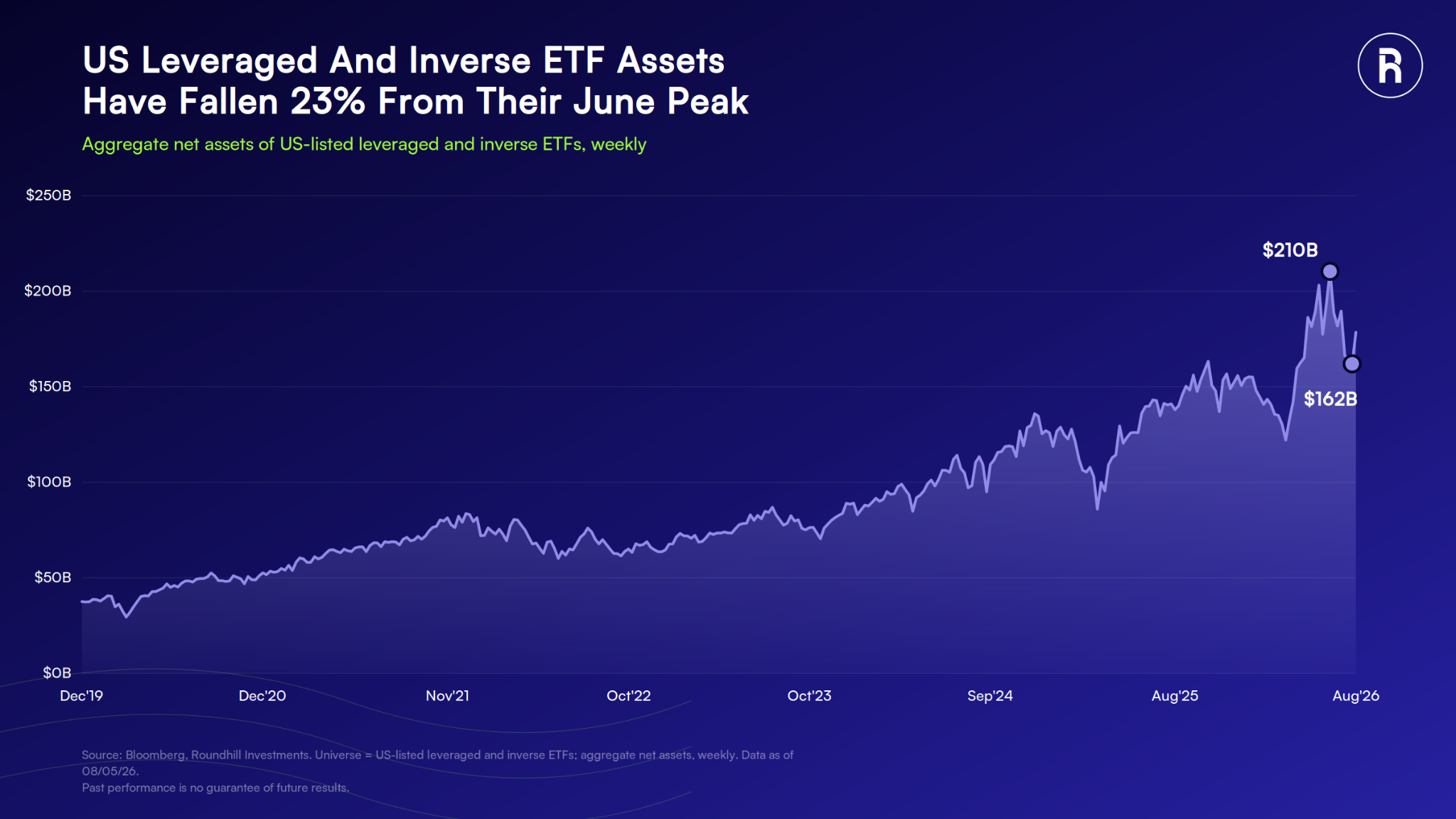
In our view, the Situational Awareness blow up was the exclamation point to a significant leverage unwind across most areas of the AI trade. That was clearly visible in the AUM growth of US listed leveraged ETFs which fell from over $200 billion in assets under management to $160 billion. Similarly, South Korean margin loan balances hit an all time high of 38.63 trillion won on June 24. By August 4, they were down to 27.40 trillion. That $40 billion drop in assets under management, accompanied by a 29% drop in Korean margin debt, gave the market the sentiment reset it needed after an extraordinary run over the past couple of months.
Following this sentiment reset, and now in the heart of a critical earnings season, we believe the market remains on sound footing from both a technical and fundamental perspective. The S&P 500 is at all-time highs on both a market cap weighted and equal weighted basis. Meanwhile, 85% of S&P 500 companies have beaten earnings expectations, tracking to a ~50% year-over-year growth rate, according to LSEG I/B/E/S data.
Despite various headwinds, stocks are in a bull market, and memory stocks and the Magnificent Seven are each giving investors reasons to stay optimistic.
Memory Stocks Have a Floor
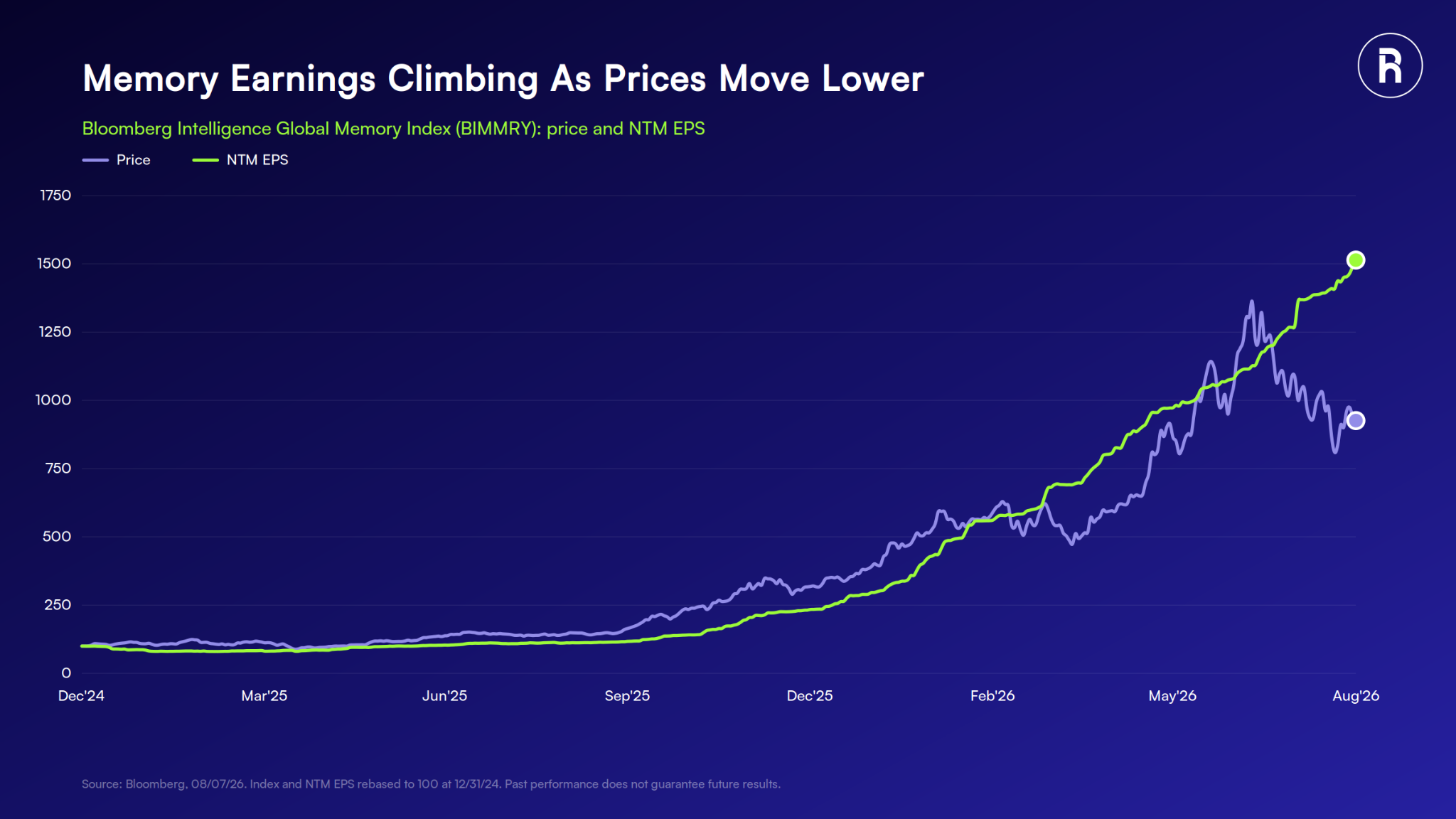
Memory stocks are likely one of the biggest beneficiaries of the recent sentiment reset. Throughout the drawdown, next twelve month earnings estimates for memory stocks continued to climb to record highs, even as prices fell. We believe this gap between falling prices and a strengthening fundamental backdrop gives these stocks a floor.
Meanwhile, earnings commentary adds even more weight to the data. Elon Musk on the SpaceX earnings call:
“Limiting factor currently is memory. Memory output is increasing by around 20% per year. Now normally that would be fantastically fast and amazing for any large mature industry. But ask yourself is the demand increasing by 20% a year? No, the demand is increasing by 200% a year, maybe higher. So if you've got demand increasing much faster than supply then Economics 101 would suggest that the price increases. It does not decrease.”
Separately, it is being reported that Micron, SK Hynix, and Samsung have fully sold out their 2027 memory (HBM and DRAM) supply. We continue to believe the base case for memory is a higher baseline of profitability, earnings, and revenue than the industry has previously seen to this point as the industry continues to transition from a cyclical one to a more consistent one driven by a growing number of long-term agreements.
The Magnificent Seven May Be Back
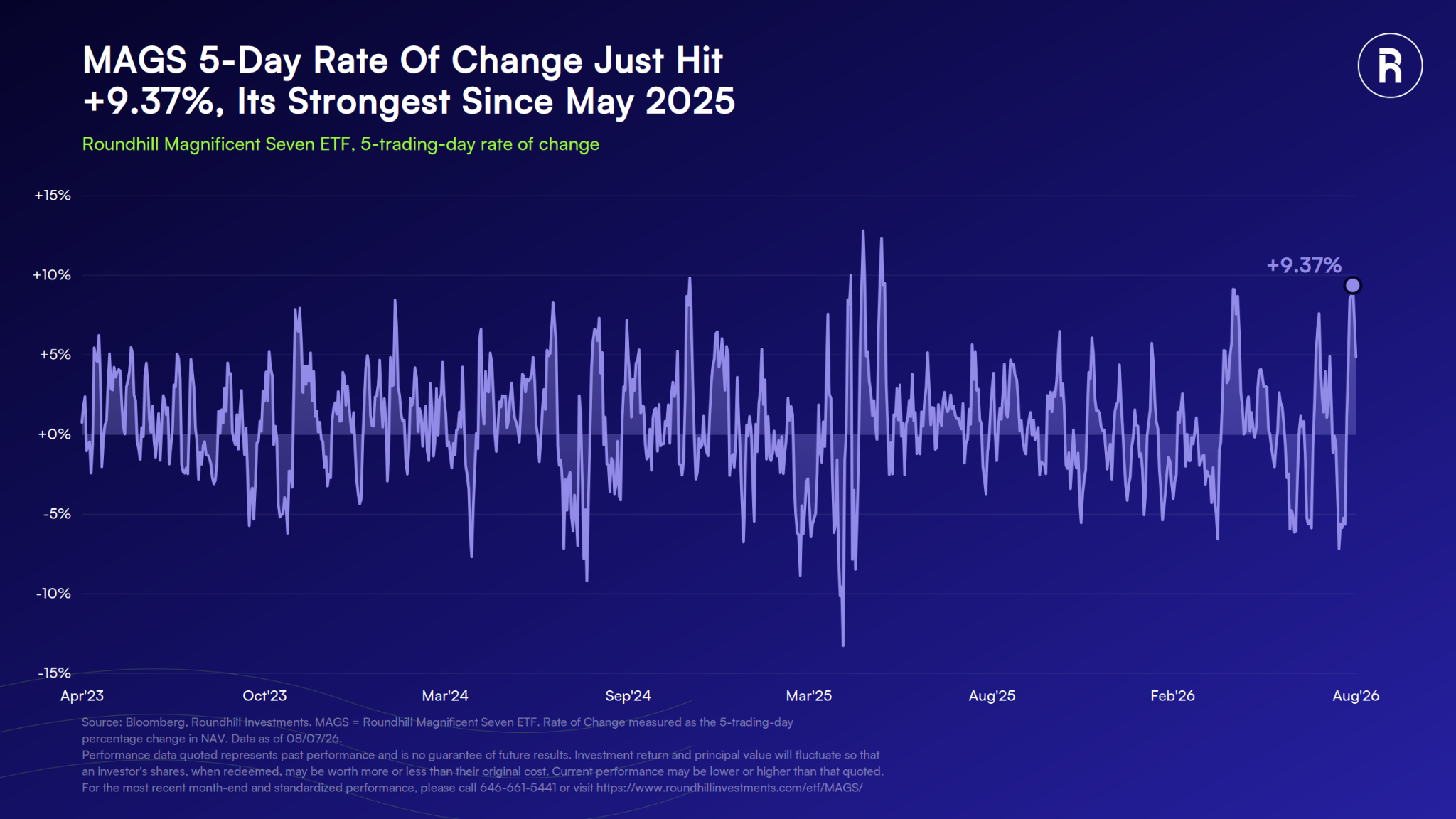
Six of the Magnificent Seven have now reported results for 2Q’26 and the group is showing signs of positive momentum. The Mag 7 posted their strongest five day return since May 2025 on August 5 up 9.4%.
We think the setup explains the move. The Magnificent Seven have been in the penalty box since October 2025, roughly flat over that stretch, while the group has drifted to its cheapest absolute next twelve month P/E in about three years, and its cheapest relative to the S&P 500 over the same window.
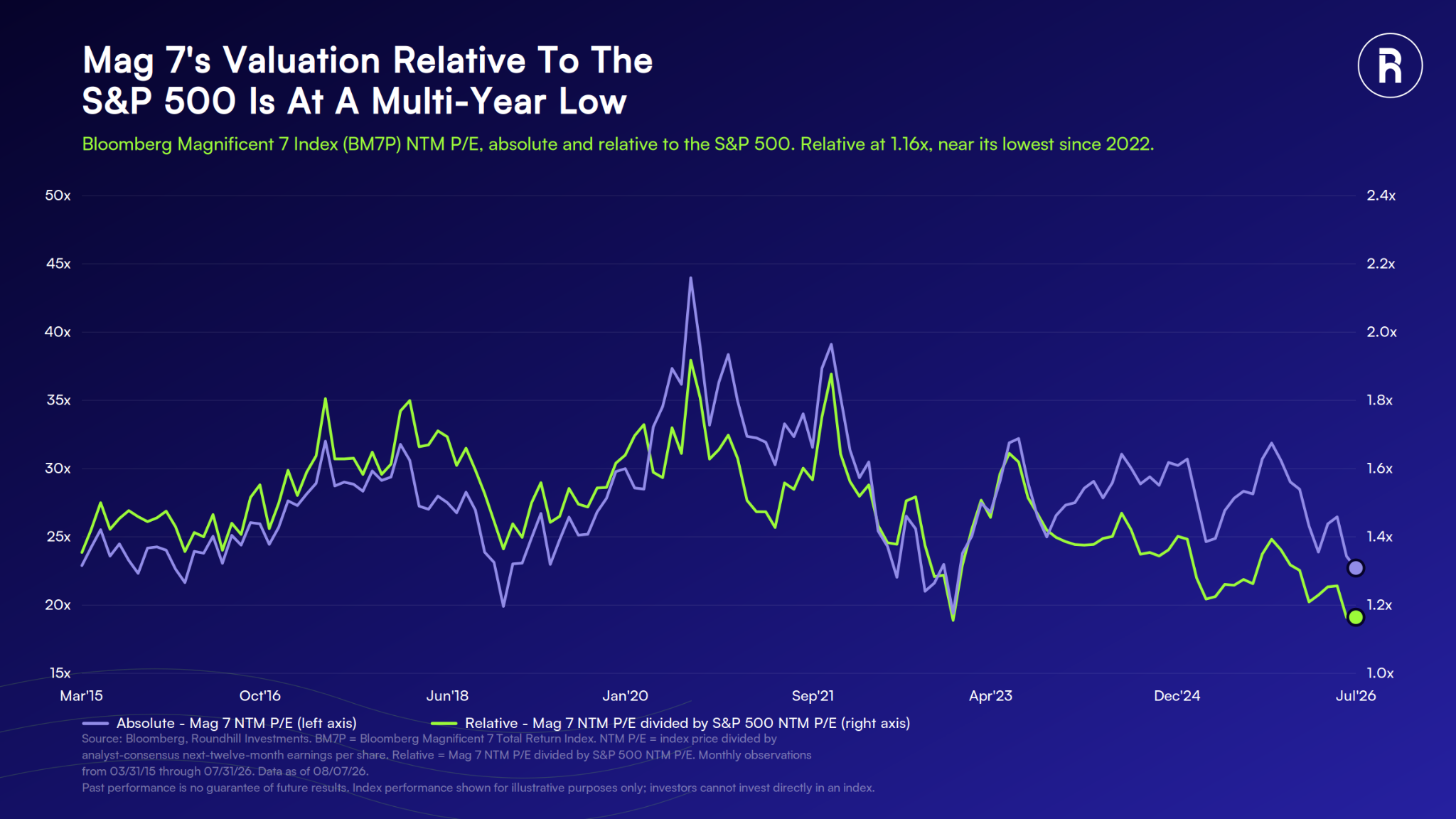
Despite not being full throated market leaders just yet, we find the risk reward compelling. Their fundamental importance to the S&P 500, measured by profit contribution, has only grown.
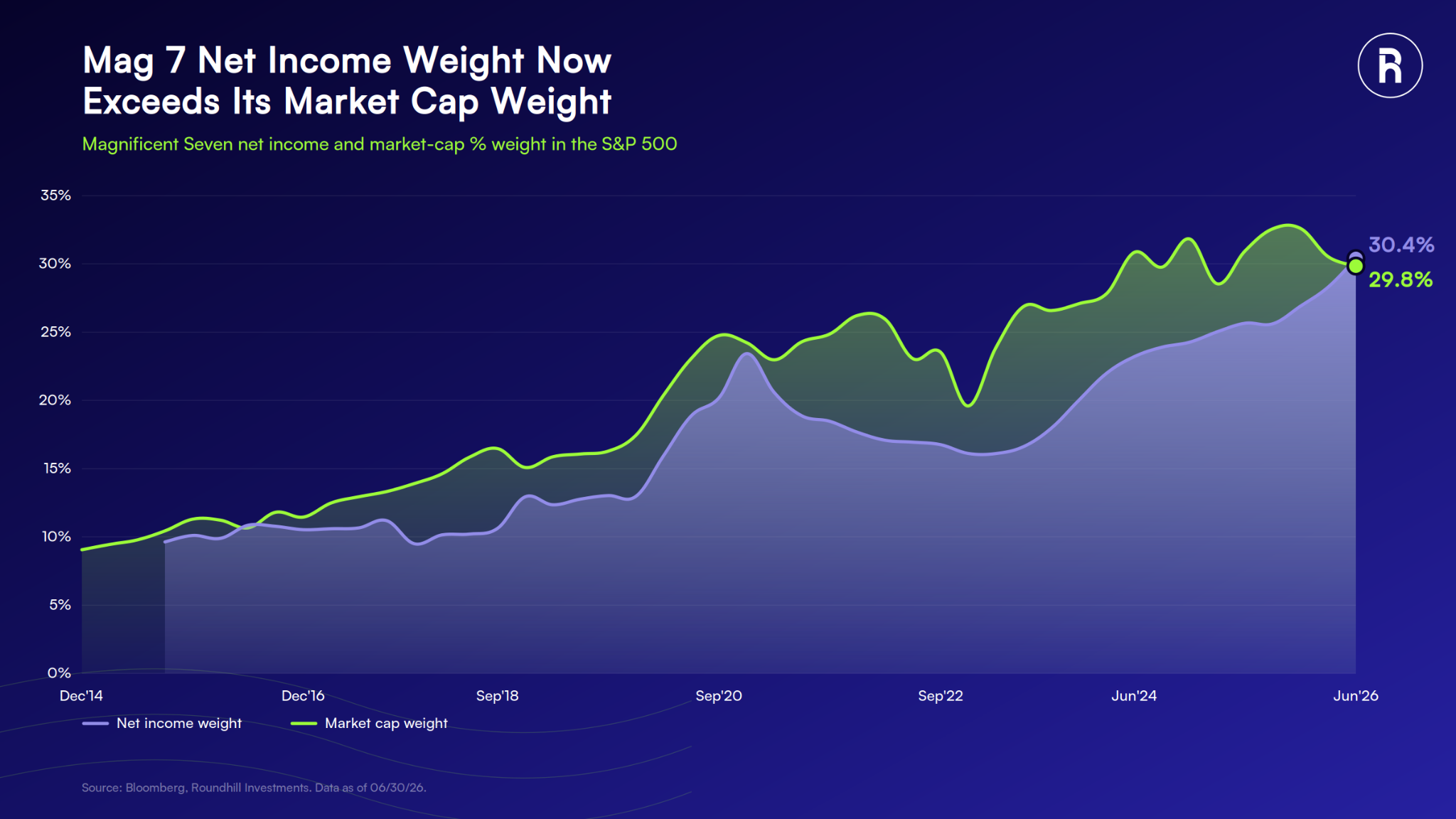
So much bad news has been priced in that investors may be starting to ask what could go right, as opposed to what could go wrong.
Green Light for the Market?
Investors have treated the Magnificent Seven and memory stocks like a barbell trade. The Magnificent Seven have been the check writers of the AI buildout while the memory producers have been the receivers. In other words, one firm's capex is another firm's revenue.
The Magnificent Seven were punished for surging capex and compressing free cash flow, while global memory stocks were feverishly rewarded as the clearest bottleneck of AI. For a stretch, the two ends came all the way apart. The Roundhill Magnificent Seven ETF (MAGS) and the Roundhill Memory ETF (DRAM) recently hit their lowest one-month correlation since DRAM's launch, at -0.08, meaning the two moved independently of one another over the month, a rare occurrence.
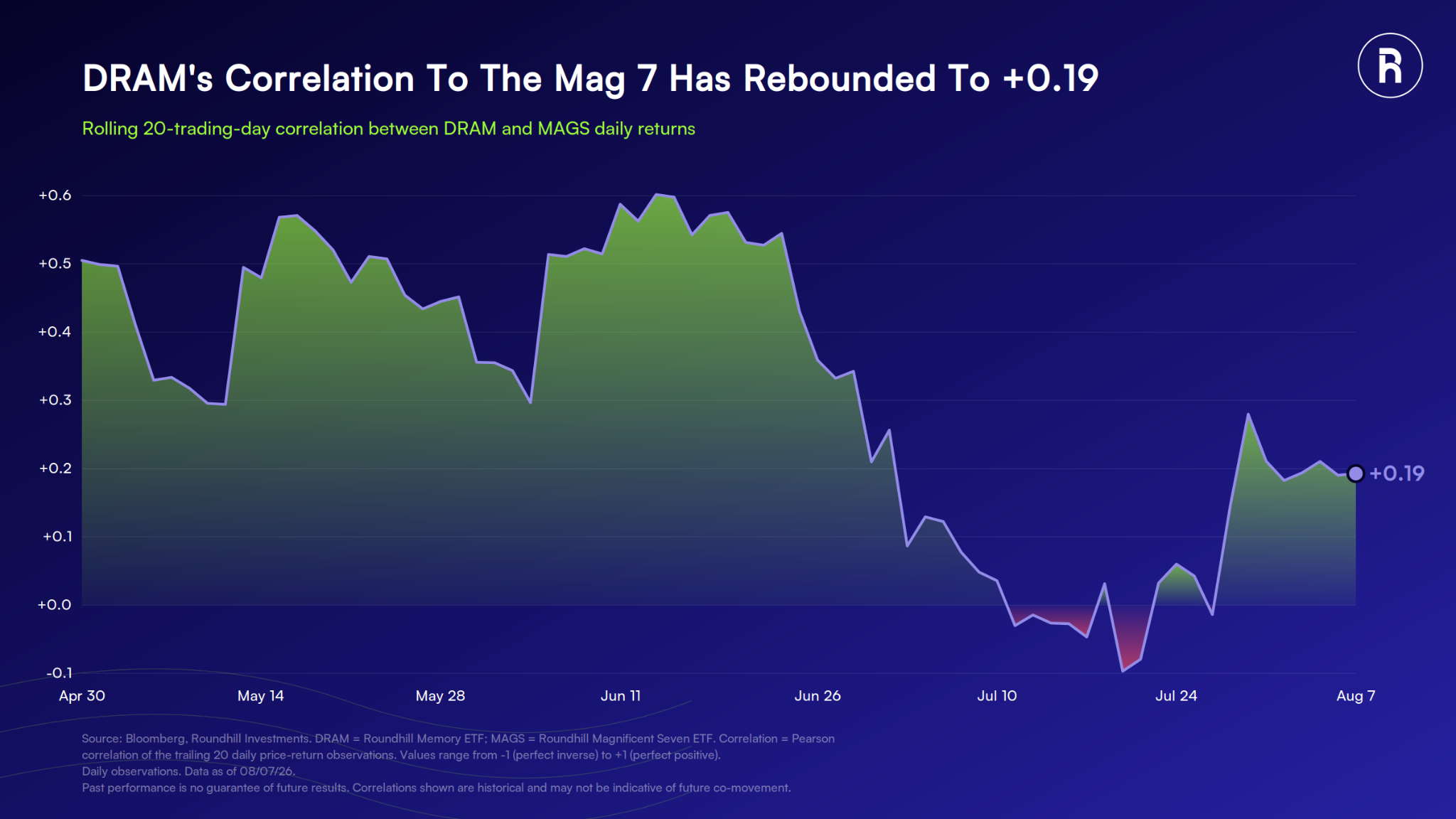
The correlation has turned higher since and now sits at 0.21. The two ends of the barbell are moving back together. For the past month, being right on memory meant being wrong on the Magnificent Seven. That is starting to change. When the check writers and the receivers get rewarded at the same time, the barbell stops splitting. In our view, that is the green light the market has been waiting for, and it may already be turning green.
DRAM Disclosures
Investors should consider the investment objectives, risks, charges, and expenses carefully before investing. For a prospectus or summary prospectus, if available, with this and other information about the Fund, please call 1-855-561-5728 or visit our website at www.roundhillinvestments.com/etf/dram/. Read the prospectus or summary prospectus carefully before investing.
Memory Companies Risk. The Fund invests in Memory Companies, which may have limited product lines, markets, financial resources or personnel and are subject to the risks of changes in business cycles, world economic growth, technological progress and government regulation. These companies are also heavily dependent on intellectual property rights, and challenges to or misappropriation of such rights could have a material adverse effect on such companies. Securities of Memory Companies tend to be more volatile than securities of companies that rely less heavily on technology. Memory Companies typically engage in significant amounts of spending on research and development, and rapid changes to the field could have a material adverse effect on a company’s operating results. Additionally, the development, manufacturing, and commercialization of semiconductor memory technologies, including HBM, DRAM and NAND, as well as related subsystems, equipment, materials, and services, are complex and evolving, and may face unforeseen technical challenges (including yield and integration issues), supply chain disruptions, intense competition and pricing volatility, regulatory developments (including export controls), and market acceptance uncertainties. As a result, investments in Memory Companies may be subject to higher levels of risk and volatility.
Semiconductor Companies Risk. The Fund invests in companies primarily involved in the design, distribution, manufacture and sale of semiconductors. Semiconductor companies are significantly affected by rapid obsolescence, intense competition and global demand. The Fund is also subject to the risk that the securities of such issuers will underperform the market as a whole due to legislative or regulatory changes. The prices of the securities of semiconductor companies may fluctuate widely in response to such events.
Line of Business Risk. Certain companies included in the Fund’s portfolio will be engaged in other lines of business unrelated to the development of memory products, and these lines of business could adversely affect their operating results. The operating results of these companies may fluctuate as a result of these additional risks and events in the other lines of business. Despite a company’s possible success in activities linked to its development of memory products, there can be no assurance that the other lines of business in which these companies are engaged will not have an adverse effect on a company’s business or financial condition.
Active Management Risk. The Fund is actively-managed and its performance reflects investment decisions that the Adviser and/or Sub-Adviser makes for the Fund. Such judgments about the Fund’s investments may prove to be incorrect. If the investments selected and the strategies employed by the Fund fail to produce the intended results, the Fund could underperform as compared to other funds with similar investment objectives and/or strategies, or could have negative returns.
Concentration Risk. The Fund is concentrated in the industry or group of industries comprising the information technology sector. The Fund may be susceptible to an increased risk of loss, including losses due to adverse events that affect the Fund’s investments more than the market as a whole, to the extent that the Fund’s investments are concentrated in the securities and/or other assets of a particular issuer or issuers, country, group of countries, region, market, industry, group of industries, sector, market segment or asset class.
Emerging Markets Risk. The Fund’s investments in emerging markets may be subject to a greater risk of loss than investments in more developed markets. Emerging markets may be more likely to experience inflation, political turmoil and rapid changes in economic conditions than more developed markets. Emerging markets often have less uniformity in accounting and reporting requirements, unreliable securities valuation and greater risk associated with custody of securities.
South Korea Risk. The Fund invests significantly in the securities of South Korean issuers. The Fund is subject to certain risks specifically associated with investments in the securities of South Korean issuers. Substantial political tensions exist between North Korea and South Korea. Escalated tensions involving the two nations and the outbreak of hostilities between the two nations, or even the threat of an outbreak of hostilities, could have a severe adverse effect on the South Korean economy. In addition, South Korea’s economic growth potential has recently been on a decline because of a rapidly aging population and structural problems, among other factors. The South Korean economy is heavily reliant on trading exports, especially to other Asian countries and the U.S., and disruptions or decreases in trade activity could lead to further declines. The South Korean economy’s dependence on the economies of Asia and the U.S. means that a reduction in spending by these economies on South Korean products and services or negative changes in any of these economies may cause an adverse impact on the South Korean economy and therefore, on the Fund’s investments. In addition, South Korea is located in a part of the world that has historically been prone to natural disasters such as earthquakes, hurricanes or tsunamis, and is economically sensitive to environmental events. Any such event may adversely impact South Korea’s economy or business operations of companies in South Korea.
Depository Receipts Risk. Depositary receipts may be less liquid than the underlying shares in their primary trading market. Any distributions paid to the holders of depositary receipts are usually subject to a fee charged by the depositary. Holders of depositary receipts may have limited voting rights, and investment restrictions in certain countries may adversely impact the value of depositary receipts because such restrictions may limit the ability to convert the equity shares into depositary receipts and vice versa. Such restrictions may cause the equity shares of the underlying issuer to trade at a discount or premium to the market price of the depositary receipts.
Preferred Securities Risk. The Fund may invest significantly in depositary receipts whose underlying securities are non-voting preferred securities. Preferred securities combine some of the characteristics of both common stocks and bonds. Preferred securities are typically subordinated to bonds and other debt securities in a company’s capital structure in terms of priority to corporate income, subjecting them to greater credit risk than those debt securities. Generally, holders of preferred securities have no voting rights with respect to the issuing company unless preferred dividends have been in arrears for a specified number of periods, at which time the preferred security holders may obtain limited rights. In certain circumstances, an issuer of preferred securities may defer payment on the securities and, in some cases, redeem the securities prior to a specified date. Preferred securities may also be substantially less liquid than other securities, including common stock.
New Fund Risk. The Fund is a recently organized investment company with a limited operating history. As a result, prospective investors have a limited track record or history on which to base their investment decision.
Non-Diversification Risk. As a “non-diversified” fund, the Fund may hold a smaller number of portfolio securities than many other funds. To the extent the Fund invests in a relatively small number of issuers, a decline in the market value of a particular security held by the Fund may affect its value more than if it invested in a larger number of issuers. The value of the Fund Shares may be more volatile than the values of shares of more diversified funds.
Swap Agreements Risk. The Fund may utilize swap agreements to derive its exposure to Memory Companies. Swap agreements may involve greater risks than direct investment in securities as they may be leveraged and are subject to credit risk, counterparty risk and valuation risk. A swap agreement could result in losses if the underlying reference or asset does not perform as anticipated. In addition, many swaps trade over-the-counter and may be considered illiquid. It may not be possible for the Fund to liquidate a swap position at an advantageous time or price, which may result in significant losses.
Roundhill Financial Inc. serves as the investment advisor. The Funds are distributed by Foreside Fund Services, LLC which is not affiliated with Roundhill Financial Inc., U.S. Bank, or any of their affiliates.
MAGS Disclosures
Investors should consider the investment objectives, risk, charges and expenses carefully before investing. For a prospectus or summary prospectus with this and other information about Roundhill ETFs please call 1-855-561-5728 or visit the website at www.roundhillinvestments.com/etf/MAGS. Read the prospectus or summary prospectus carefully before investing.
Investing involves risk, including possible loss of principal. The Fund expects to have concentrated (i.e., invest more than 25% of its net assets) investment exposure in one or more of the Technology Industries at any given time, which may vary over time. Further, the Fund expects to obtain such investment exposure by transacting primarily with a limited number of financial intermediaries conducting business in the same industry or group of related industries. As a result, the Fund is more vulnerable to adverse market, economic, regulatory, political or other developments affecting those industries or groups of related industries than a fund that invests its assets in a more diversified manner. The value of stocks of information technology companies and companies that rely heavily on technology is particularly vulnerable to rapid changes in technology product cycles. Please see the summary and full prospectuses for a more complete description of these and other risks of the Fund.
Roundhill Financial Inc. serves as the investment advisor. The Funds are distributed by Foreside Fund Services, LLC which is not affiliated with Roundhill Financial Inc., U.S. Bank, or any of their affiliates.