Introduction
In options markets, most strategies are designed to take a view: bullish, bearish, or somewhere in between. But some structures are designed to take no equity view at all. Some exist purely to extract interest rates and convert equity exposure into a fixed-income-like return.
One of the most elegant examples is the box spread. A box spread is a combination of calls and puts that, when constructed, has no directional exposure to the underlying asset. Instead, it represents a synthetic loan or bond. It does so by locking in the implied financing rate embedded in option prices.
Can I Make a Box Spread?
A box spread is created by buying a bull call spread and also buying a bear put spread on the same underlying, using the same strike prices and same expiration date.
When this exposure is mocked up in a payout chart, you can see why the net transaction results in zero exposure to the underlying asset’s price movement.
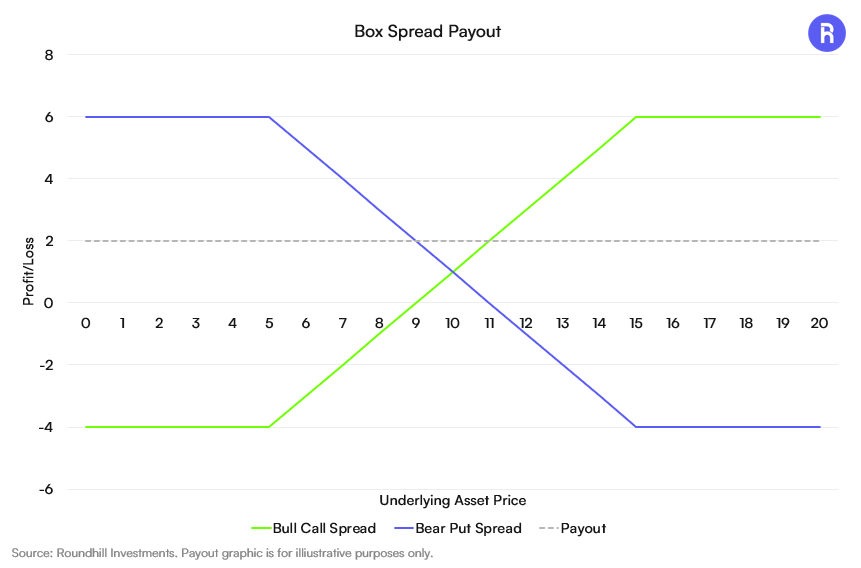
The long bear put spread (purple line) costs $4 dollars on trade date. The long bull call spread (green line) costs $4 on trade date. On expiration, regardless of where the underlying asset falls, the package’s net expiration yield will be $10, or the difference between the strikes. Speaking in fixed-income terms, this is the “face value” of your box spread. How is that possible? Well…
- If the underlying asset ends at $3 (below the lower strike), the bear put spread will end 100% in-the-money and payout will be the long strike of $15 minus the short strike of $5.
- If the underlying asset ends at $10 (in between strikes), both the bear put spread and bull call spread will end partially in-the-money. The payout will be the asset price of $10 - the long call strike of $5 plus the long put strike of $15 - the asset price of $10, resulting in a yield of $10.
- If the underlying asset ends at $20 (above the upper strike), the bull call spread will end 100% in-the-money and payout will be the short strike of $15 minus the long strike of $5.
Because I spent $8 to put this position on and my yield will always be $10, regardless of market conditions, I have locked-in a $2 return, which is displayed in the grey dotted line. This is how a box spread turns equity instruments into a fixed-income vehicle. As an investor, you know on day 1: initial spend or premium, face value, tenor, and rate of return. When described that way, it’s near identical to a zero-coupon bond.
Turning Equity Exposure into Fixed Income
What makes box spreads unique is that they strip out all equity risk. By holding offsetting call and put spreads, the investor neutralizes exposure to the underlying stock or index, leaving only the financing component, or the same rate that would exist if you borrowed or lent cash against that collateralized equity position.
Because of this, institutional traders often use box spreads to:
- Earn the implied risk-free rate in the options market,
- Lock in synthetic lending/borrowing positions, or
- Arbitrage small differences between option-implied and Treasury rates.
Box Spreads in ETFs
Box spreads can be a powerful tool for portfolio construction. Compared to buying Treasuries, using options can provide:
- Tax Efficiency: Certain index options (like SPX) are treated as Section 1256 contracts, meaning gains and losses receive 60% long-term / 40% short-term blended capital-gains treatment, regardless of holding period.
- No Dividends or Income: Unlike bonds which payout coupon payments that are taxed, the interest rate gain on a box spread can be wrapped into capital appreciation of an ETF’s price.
- Operational Simplicity: A single set of option positions can replicate a large notional Treasury holding.
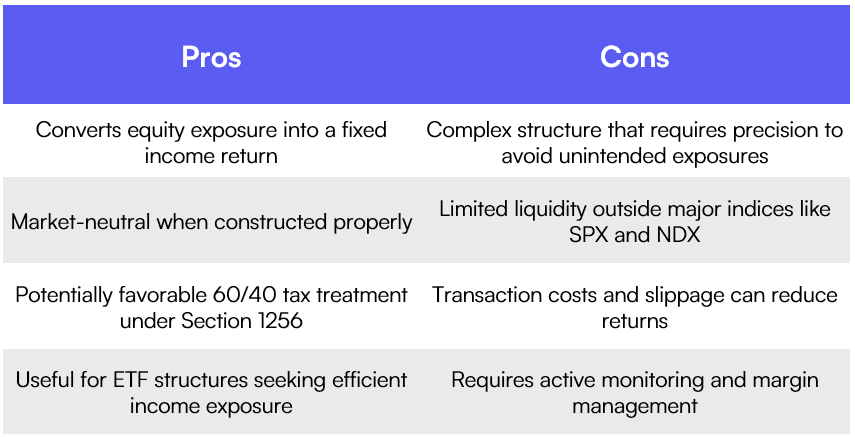
Pros and Cons of Box Spreads
Conclusion
Box spreads are an incredibly interesting expression of options. Investors found a way to take one of the riskiest trading tools in the market and turn it into a risk-neutral structure that behaves like a bond.
When implemented within an ETF, box spreads take on even greater appeal. They can deliver bond-like returns while maintaining the transparency and liquidity of listed options. And thanks to the benefits of the ETF wrapper, they may even offer a more tax-advantaged alternative to traditional fixed-income instruments.
Disclosures
Carefully consider the investment objectives, risks, charges and expenses of Roundhill ETFs before investing. This and other information about each fund is contained in the Prospectus and Summary Prospectus. Please read the prospectus and summary prospectus carefully before investing as it explains the risks associated with investing in the ETFs. Each Fund prospectus can be found on the individual Fund page under https://www.roundhillinvestments.com/etf/.
All investing involves risk, including the risk of loss of principal. There is no guarantee an investment strategy will be successful.
Roundhill’s funds are distributed by Foreside Fund Services, LLC.