As secular adoption of AI has matured, innovation and disruption have accelerated, challenging business models and the status quo.
Most companies are being left with a profound and difficult realization: innovate or get left behind.
However, not all companies have to play by AI's rules. This group of stocks is considered more resistant to AI disruption than others. Collectively, this group is known as Heavy Asset, Low Obsolescence (HALO) stocks.
What Makes HALO Stocks Special?
HALO stocks are heavy asset companies with low risk of obsolescence in the age of AI. Their value is grounded in tangible physical assets, real-world operations, or long-established infrastructure that AI cannot easily replicate. These companies have stood the test of time, withstanding seismic technological upheavals like the dot-com bubble, and now potentially the generative AI revolution. In fact, many have been operating for over a century and some since before the lightbulb.
What makes these companies potentially resistant to AI disruption is the nature of their value. AI can analyze, predict, and optimize, but it cannot lay a pipe, install a billboard, or replace the physical infrastructure that modern life depends on. In some cases, they may even benefit from AI through automation, predictive maintenance, and operational efficiency. Many of these businesses also operate behind structural moats: regulatory protections, multi-decade customer relationships, and specialized manufacturing knowledge. None of those become cheaper or more replicable when a large language model improves.
That’s a Public Company?
Some HALO Stocks provide the infrastructure that allows cities, homes, and businesses to function. These companies offer products that have to exist for modern life to operate and you may encounter every day without ever noticing.
Mueller Water Products (MWA) is one example. Mueller has been making fire hydrants since 1857. The familiar red or yellow hydrant on the corner of your street is likely theirs. So are the valves running beneath the road, the water meters in front of your house, and the brass fittings inside your plumbing.
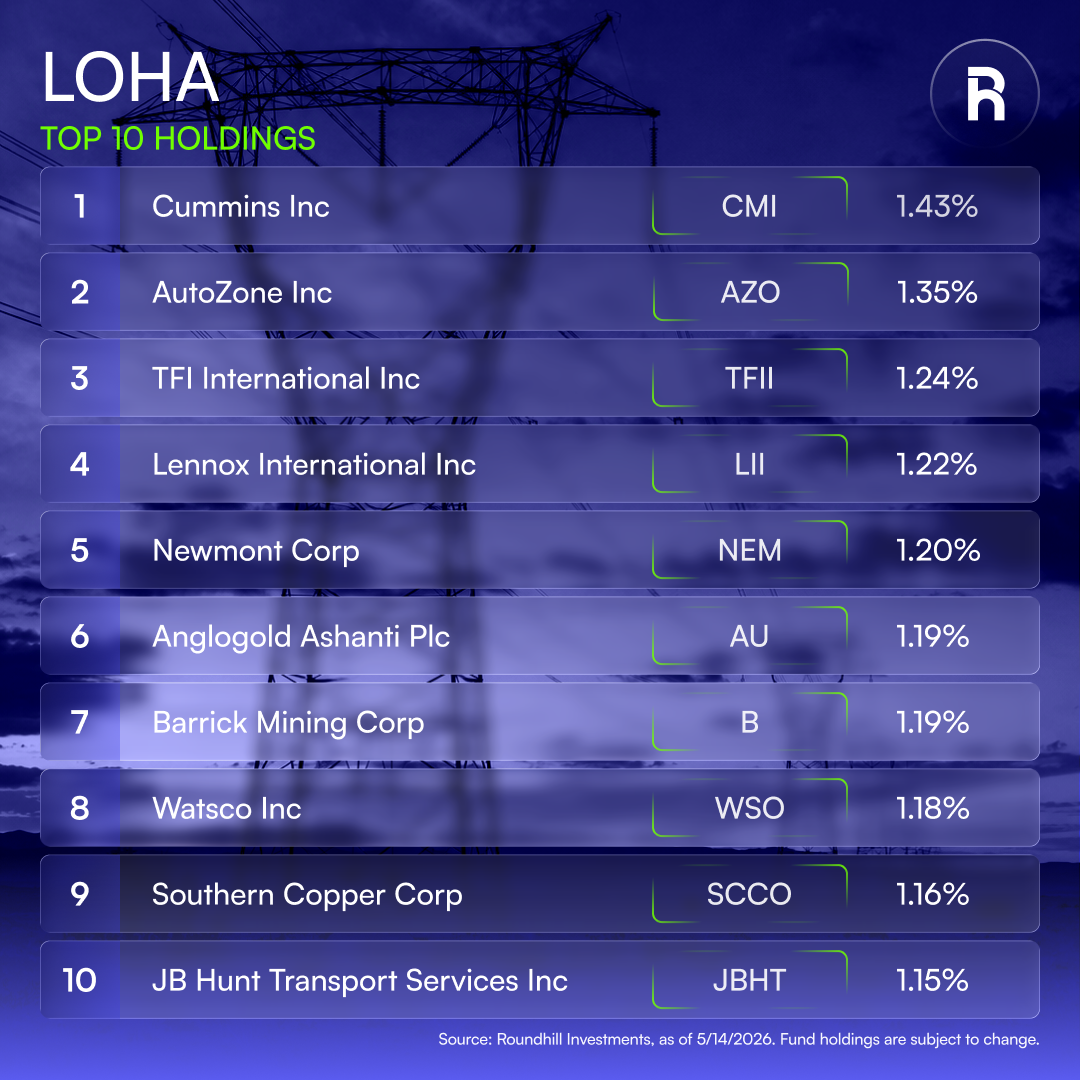
Watsco (WSO) is the largest HVAC distributor in North America, moving products to thousands of contractors nationwide. Lennox International (LII), founded in 1895, manufactures the heating and cooling systems that sit in millions of American homes. A.O. Smith (AOS) has been making water heaters since 1874.
Advanced Drainage Systems (WMS) makes the corrugated plastic stormwater pipes underneath the parking lots, subdivisions, and data center campuses being built across the country. Allegion (ALLE) owns Schlage, which is likely the brand of the deadbolt on many homes’ front doors.
Brands You May Know
HALO stocks can also be closely related to some familiar brands. Some of the most durable businesses in the economy are durable precisely because they own, carry, or supply the brands you encounter every day..
Start with Lamar Advertising (LAMR). Lamar is a public company whose business is owning billboards and outdoor advertising space across the United States. Most billboards along I-95, on every commercial corridor in America, is real estate they likely own and lease out to advertisers.
Hershey (HSY), founded in 1894, owns far more than chocolate: Reese's, Kit Kat, Twizzlers, Jolly Rancher, Ice Breakers, and Skinny Pop are all subbrands. Lamb Weston (LW) is the largest frozen French fry producer in North America and is McDonald's, Wendy’s and Chick-Fil-A’s supplier.
The Quiet Recyclers and Movers
HALO stocks do the invisible work of the physical economy: the logistics, the cleanup, and the heavy lifting. Most investors don't realize these companies are public.
Kirby Corporation (KEX) is the largest inland barge operator in the United States. Most of the fuel barges moving up and down the Mississippi belong to Kirby. Matson (MATX) ships containers between the U.S. mainland and Hawaii, Alaska, and Guam. The Jones Act has insulated their Hawaii route for over a century. Most of what arrives at a Honolulu Costco crosses the Pacific on a Matson ship.
Crown Holdings (CCK) makes aluminum cans. Modelo, White Claw, and Liquid Death all ship in Crown cans. Waste Management (WM) hauls the trash. Their green-and-yellow trucks are seen on most streets throughout America.
Meet LOHA
The Roundhill HALO ETF (LOHA) seeks to provide equal weight exposure to 100 companies that fit the HALO framework. Most U.S. investors may already be heavily exposed to AI and the disruption risk it introduces. LOHA offers unique exposure to a different part of the market, one that looks dissimilar from the indices driving that exposure today.
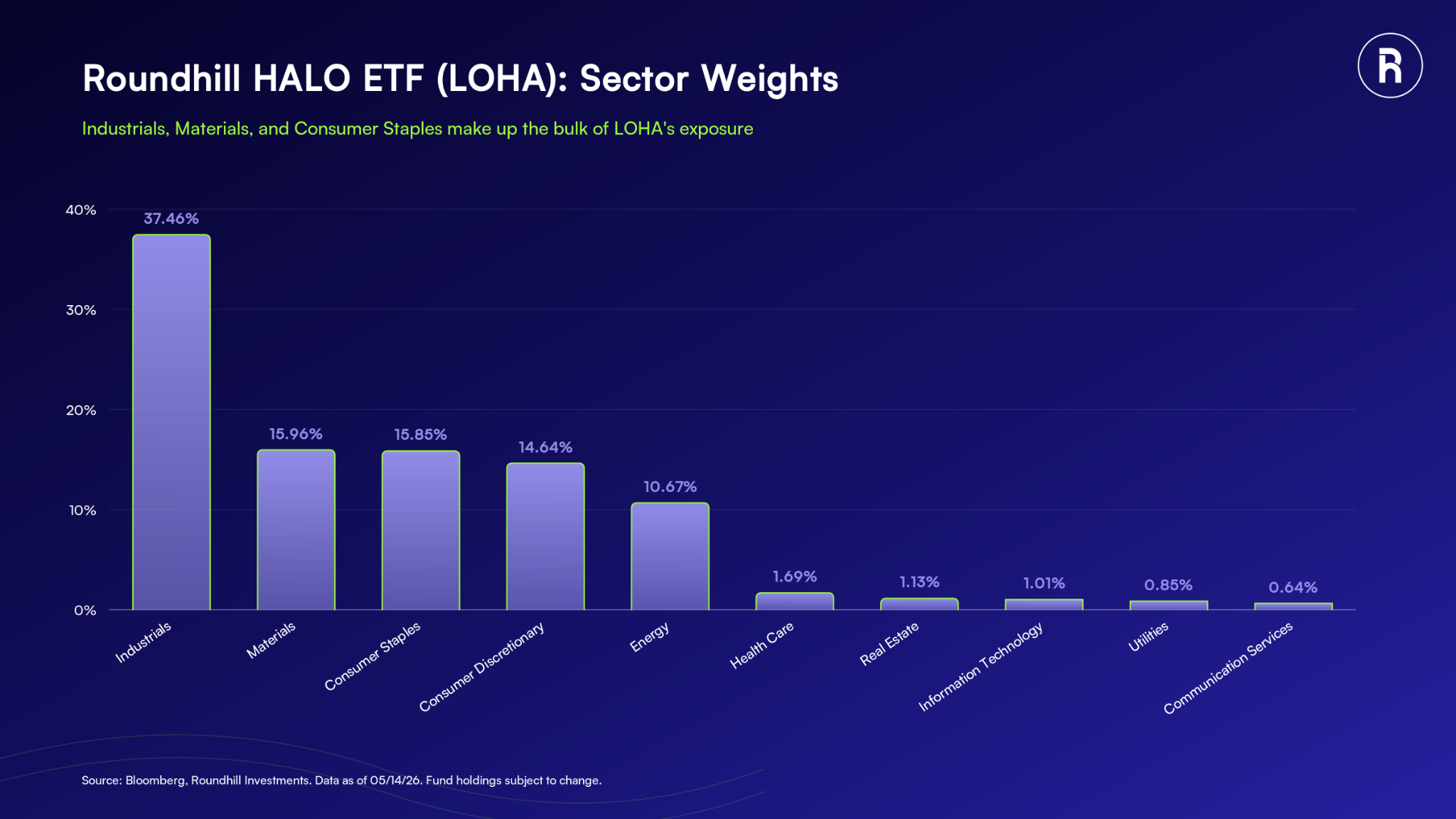
Industrials lead the basket by a wide margin, with meaningful allocations to Consumer Staples, Materials, Consumer Discretionary, and Energy. Together, those five sectors account for the vast majority of the portfolio.
The most striking exposure is the smallest. Information Technology represents a minimal share of LOHA. By comparison, Technology represents roughly 30% of the S&P 500.
Just as notable is what is missing. There is no Magnificent Seven. There are no hyperscalers. There is no AI mega-cap. LOHA is the part of the U.S. equity market that the AI narrative has, so far, ignored.
Learn More About LOHA: https://www.roundhillinvestments.com/etf/loha/
Investors should consider the investment objectives, risk, charges and expenses carefully before investing. For a prospectus or summary prospectus with this and other information about Roundhill ETFs please call 1-855-561-5728 or visit the website at https://www.roundhillinvestments.com/etf/loha/. Read the prospectus or summary prospectus carefully before investing.
HALO Companies Risk. The Fund will invest substantially all of its assets in companies identified by the Index Provider as HALO Companies. U.S.-listed companies whose economic value is anchored to tangible physical assets, real-world operations, and long-established brand and infrastructure moat. As a result, the Fund’s performance will be disproportionately exposed to the risks inherent HALO Companies. HALO Companies typically require significant ongoing capital expenditures to maintain, upgrade and expand their infrastructure, and their financial performance may be adversely affected by rising construction costs, supply chain disruptions, labor shortages, equipment failures, and delays in permitting or project completion. Because these companies often rely on substantial debt financing to fund assets, they may be particularly sensitive to changes in interest rates, credit availability, and broader capital market conditions, which could increase borrowing costs, reduce refinancing flexibility, and compress equity valuations. Many HALO Companies operate in regulated or quasi-regulated industries, and adverse regulatory actions, changes in tariff structures, environmental compliance mandates, or shifts in public policy may materially affect revenues, returns on invested capital, or asset values. Although HALO Companies are generally thought to be characterized by a lower risk technological obsolescence, they may nonetheless face disruption from evolving energy technologies, changes in consumer behavior, decarbonization initiatives, or alternative infrastructure solutions that impair the economic usefulness of legacy assets. The direction of technology is ultimately unknowable and companies thought to be subject to lower risk of technological obsolescence may nonetheless find their business models increasingly obsolete. In addition, the long-duration nature of their assets and cash flows may make HALO Companies more sensitive to inflation expectations and interest rate changes. Because the Fund’s strategy emphasizes a particular class of companies with similar structural characteristics, it may underperform broader equity markets, particularly during periods in which asset-light, technology-oriented, or higher-growth companies outperform capital-intensive sectors. Consequently, an investment in the Fund involves heightened risks associated with investing in companies selected for HALO characteristics and may experience greater volatility or sustained periods of underperformance relative to diversified equity funds that are not focused on such companies.
Industrials Sector Risk. The value of securities issued by companies in the industrials sector may be adversely affected by supply and demand changes related to their specific products or services and industrials sector products in general. The products of manufacturing companies may face obsolescence due to rapid technological developments and frequent new product introduction. Global events, trade disputes and changes in government regulations, economic conditions and exchange rates may adversely affect the performance of companies in the industrials sector. Companies in the industrials sector may be adversely affected by liability for environmental damage and product liability claims. The industrials sector may also be adversely affected by changes or trends in commodity prices, which may be influenced by unpredictable factors. Companies in the industrials sector, particularly aerospace and defense companies, may also be adversely affected by government spending policies because companies in this sector tend to rely to a significant extent on government demand for their products and services.
Concentration Risk. The Fund may be susceptible to an increased risk of loss, including losses due to adverse events that affect the Fund’s investments more than the market as a whole, to the extent that the Fund’s investments are concentrated in the securities and/or other assets of a particular issuer or issuers, country, group of countries, region, market, industry, group of industries, sector, market segment or asset class.
Index Provider Risk. There is no assurance that the Index Provider, or any agents that act on its behalf, will compile the Index accurately, or that the Index will be determined, maintained, constructed, reconstituted, rebalanced, composed, calculated or disseminated accurately. The Index Provider and its agents do not provide any representation or warranty in relation to the quality, accuracy or completeness of data in the Index, and do not guarantee that the Index will be calculated in accordance with its stated methodology.
New Fund Risk. The Fund is a recently organized investment company with a limited operating history. As a result, prospective investors have a limited track record or history on which to base their investment decision.
Non-Diversification Risk. As a “non-diversified” fund, the Fund may hold a smaller number of portfolio securities than many other funds. To the extent the Fund invests in a relatively small number of issuers, a decline in the market value of a particular security held by the Fund may affect its value more than if it invested in a larger number of issuers. The value of the Fund Shares may be more volatile than the values of shares of more diversified funds.
Roundhill Financial Inc. serves as the investment advisor. The Funds are distributed by Foreside Fund Services, LLC which is not affiliated with Roundhill Financial Inc., U.S. Bank, or any of their affiliates.